A regulated category where the wrong sentence becomes a legal problem. What a creator can say, what they cannot, and the briefs that work.
Why the category buys creator video
Four reasons this category is a buyer.
The products are bought after advice, and video replaces the counter conversation when the purchase happens online.
The gestures count as much as the formula: quantity, order of application, frequency.
Visual proof of texture and absorption cannot be obtained in a photograph.
And competition on the shelf is strong, which pushes towards showing the product in real use.
What a creator can say, and cannot
Five things generally possible.
Describing their personal use: when, how, how often.
Describing a sensation or a texture, without drawing a medical conclusion from it.
Reading a mention appearing on the packaging, without rephrasing it.
Referring to a health professional for any advice.
And showing the gesture, which is often the real useful content.
Five things to exclude by default.
Any statement of treating, curing or preventing.
Any promise of a result, quantified or implied.
Any before-and-after suggesting a guaranteed effect.
Any recommendation of dosage or of combining products.
And any testimonial presented as a patient's.
One rule that simplifies everything: the creator talks about what they do, never about what the product does.
The briefs that work
The routine
The order of use over a day, filmed continuously, with no promise. It is the most watched and the safest format.
The texture close-up
The material, the spreading, the absorption, filmed in extreme close-up and in natural light. No word is needed, which removes the risk.
The honest comparison
Two formats of the same product, or two uses, with what suits each. Comparison between competing brands is to be set aside.
The pharmacy visit
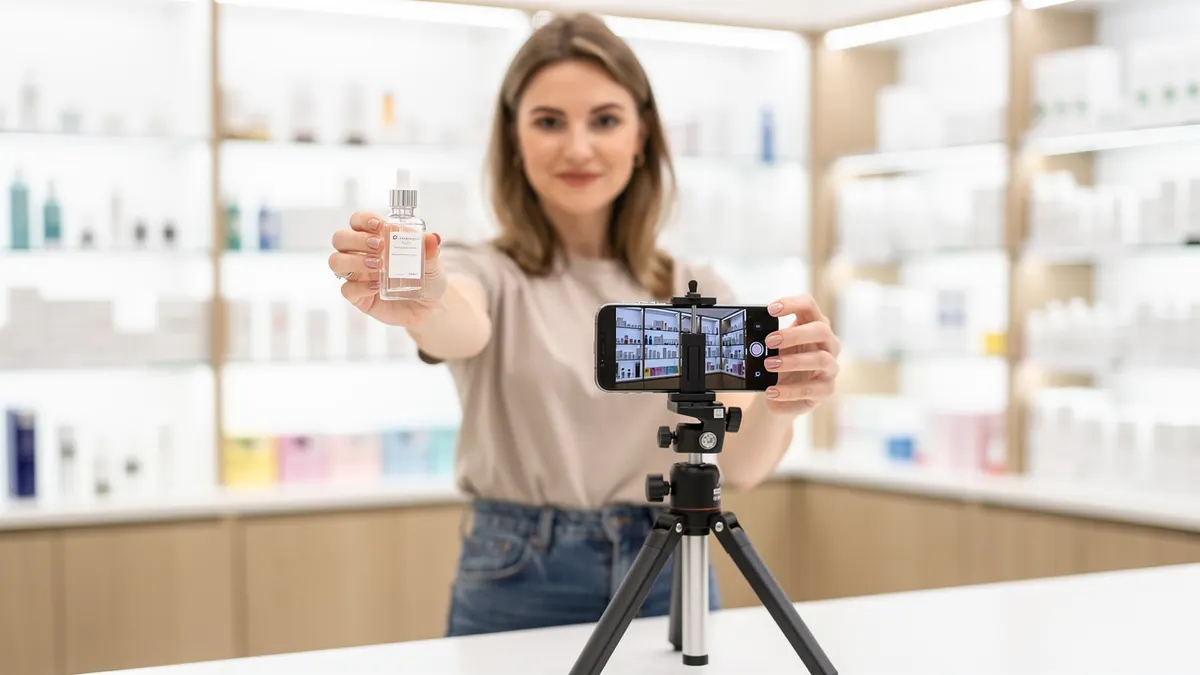
The walk down the aisle, the question asked at the counter, the referral to the professional. That format requires filming permission from the establishment.
The seasonal one
Needs that change with the season, a legitimate subject and easy to handle with no claim.
What can be said, and in what form
| The product | Possible wording | Forbidden wording |
|---|---|---|
| A hygiene product | Its texture, its scent, its use | An effect on a condition |
| A supplement | What the label states | A cure or a timeframe |
| A device | How it handles | A diagnosis |
What separates one aisle from another
A product sold in open access does not follow the same rules as one dispensed at the counter. That line is checked product by product, with the pharmacist and the manufacturer.
What is never filmed
A prescription, an identifiable customer at the counter, a price shown on a medicine, and a professional's advice presented as a general recommendation.
Practical rules for the brand
Six rules that avoid incidents.
Supply the list of permitted claims with the brief, never after.
Prohibit improvisation: the script is approved and shot as it stands.
Prepare the answers to comments, which commit you as much as the video.
Prohibit any answer by the creator to a personal health question received in a private message.
Archive each published version with its date and its wording.
And provide a rapid removal procedure, applicable within hours.
One last marker: in this category the constraint protects the brand as much as the public. A video showing a gesture, stating a sensation and referring to a professional sells better than a video promising a result, because the promise is exactly what the public has learned to stop believing.