A category built on control will not entrust its image to somebody outside. What it can entrust is everything that happens after the purchase, and that calls for a different way of filming.
What the format will not do here
Three things, worth naming.
It will not carry the brand's story, which is built over years and controlled word by word.
It will not show the product in an aspirational setting, because that register belongs to photography and to internal production.
And it will not serve as mass social proof: in this category, rarity is worth more than numbers.
A brand asking for the opposite will get videos that damage its position, and that is the only real mistake available here.
The moment after the purchase
That is where the format becomes valuable.
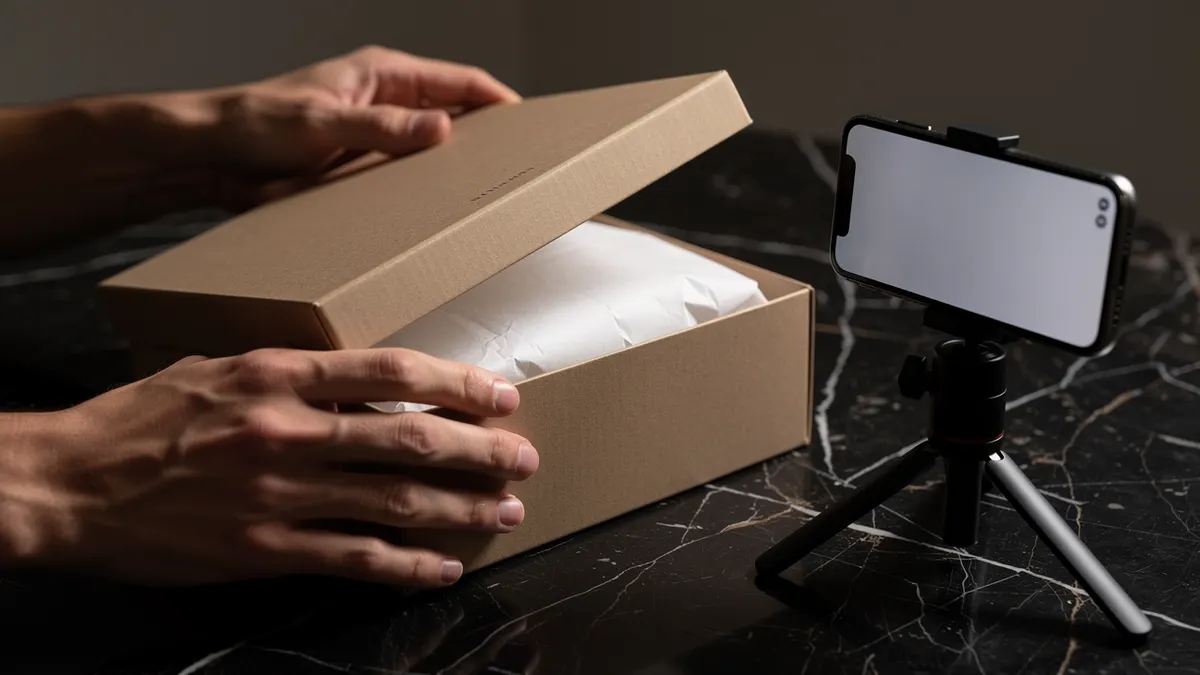
The real unboxing, in real time, with the packaging, the storing, the weight, the material. That moment is experienced by every customer and filmed by almost nobody, although it carries a large part of the satisfaction.
Add the first use, the first care, and the place where the object lives when it is not in use. Those are sequences the brand cannot produce itself without them ringing false.
Service and warranty
That is the strongest and least exploited angle.
In this category, what justifies the price is not only the object, it is what surrounds it: the repair, the servicing, the part still available ten years later, the person who answers the telephone.
Filming that path, with real timings, produces content competitors cannot copy quickly. It is also the hardest content to obtain internally, because it obliges the brand to show its own service as it is.
The long life of the object
Two sequences, and they are commissioned in advance.
The object after two years of use, in the same house, filmed the same way. And the resale or the passing on, where the category allows it.
That content says something advertising cannot say: that the purchase was justified. It takes patience and a contract that plans the deferred sequence from the first shoot.
The rules to set
Four, and they are set in the brief.
No claim about materials, origin, certifications, durability or environmental characteristics that does not come from the brand's approved documentation. Those points are checked with the competent authority and with a lawyer before going live.
No improvising about price, availability or resale value.
Disclosure of the commercial nature of the collaboration, planned at the shoot and not added afterwards, in line with the obligations applicable to the channel and the agreement.
And a written right of withdrawal: in this category more than others, the brand has to be able to ask for distribution to stop, and the creator has to know on what conditions and against what compensation.
What sets a high-end shoot apart
| Element | Standard expectation | Premium expectation |
|---|---|---|
| Background | An ordinary interior | A plain surface, no clutter |
| Hands | Barely noticed | Groomed, slow gestures |
| Sound | An audible voice | Clean silence, no echo |
What is contracted before the shoot
Script approval, the number of revisions, the licence duration and any ban on posting from your own account.
What loses the client
A product set down carelessly, a shot showing damaged packaging, a light that betrays a material.
Which creators to hire
Few, for a long time, and paid accordingly.
A creator who comes back three times a year for two years builds a familiarity that resembles a client relationship, which is exactly this category's register. Ten different creators produce the opposite effect.
Check three things: steadiness of hand in close-up, the ability to film without music, and discretion online. In this category, what the creator publishes elsewhere is part of the contract.
Sources
- Urssaf, official auto-entrepreneur portal
- Service Public, how to become a micro-entrepreneur
- Service Public, crossing the micro-entrepreneur turnover thresholds
Checked on 4 September 2026. Thresholds and rates change: where this guide and the official source disagree, the official source is right.