The video that belongs on a listing is not the one that belongs in an advert. It is not looking for anybody: it reassures somebody who is already there.
Show the way out
That is the principle structuring the whole video.
On a listing, the person is looking for a reason to say yes, but first they are looking for the absence of a reason to say no.
So handle the objections in the order they arise: the real size, the material, compatibility, maintenance, delivery time, service.
And do not hide the product's limits. A video saying what the object does not do is more credible than one listing only qualities, and it reduces returns.
Answer the questions in the reviews
That is the most reliable writing source, and it is free.
Take the last twenty comments and questions published on the listing, including competitors'. Five questions come back almost every time.
The video answers those five questions, in order, with no introduction and no conclusion.
It is twenty minutes of work, and it beats a script written by somebody who has never sold the product.
Silent playback is the norm
That is the main technical constraint, and it decides the edit.
Playback starts silent, often in a reduced window, sometimes in degraded quality.
Three consequences. Burnt-in subtitles are not optional. No essential information must exist only in the audio. And on-screen text must stay legible at half definition, so large, short and centred.
Add a first-frame rule: it must show the product in use, not a logo.
Marketplace rules are precise
They differ from one platform to another, but four prohibitions come back.
No price or promotion burnt into the image.
No link, address or name of another shop.
No named comparison with a competitor.
And no unverifiable claim, particularly on health, safety and performance.
These rules are checked in the platform's terms before going live, because a rejection is not only a delay: it is a listing left without a video during the period when it sells.
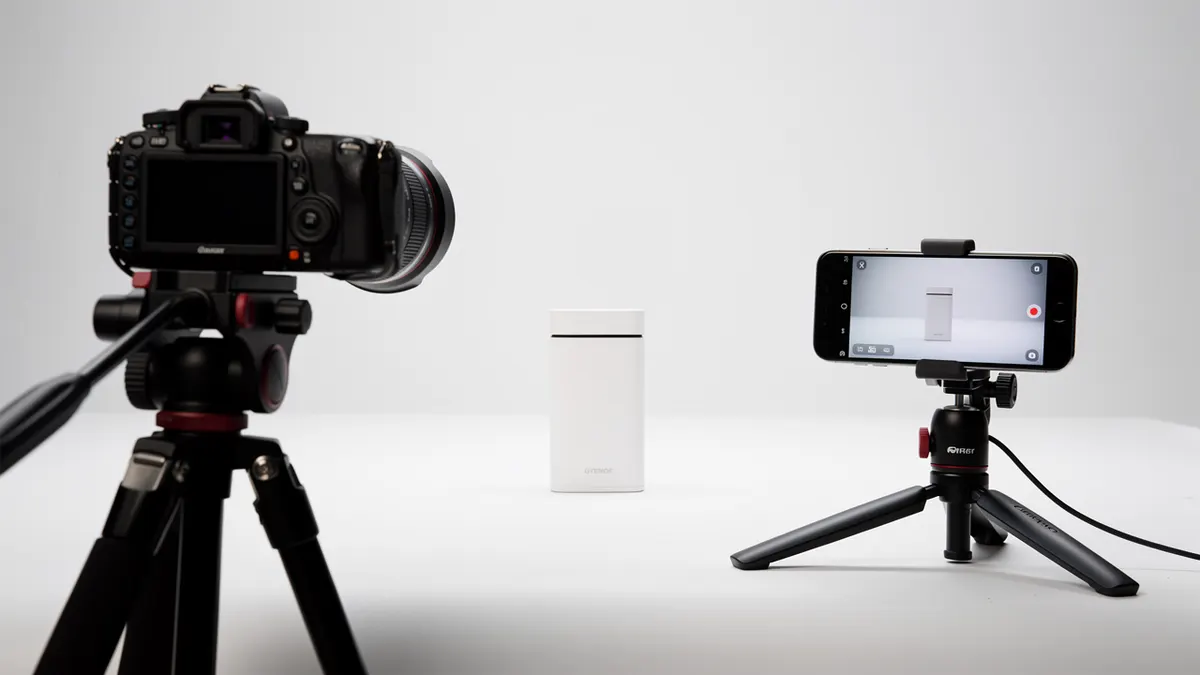
One video per reference
That is the rule that costs the most and pays the most.
A generic video placed on thirty listings brings no returns down. A video showing exactly the reference ordered brings down the returns of that reference.
So organise production in batches: ten products in the same day, same set, same person, industrialised editing.
What doubt each shot must remove
| Doubt | The shot | Length |
|---|---|---|
| The real size | The object held, next to a hand | 4 s |
| The box contents | Everything laid out, from above | 6 s |
| Daily use | The gesture, uncut | 12 s |
What repeats identically across the whole catalogue
The background, the lens height, the distance and the order of the shots. A consistent series is browsed fast, and one page that breaks the pattern loses the trust earned on the others.
What is checked before going live
The file name, the linked reference, the orientation and that the first frame is neither black nor blurred.
What to ask for beyond the edit
Four deliverables, written into the order.
The rushes, or at least a master with no burnt-in text and no music.
A square version and a vertical version from the same takes.
A ten-second short version for advertising inside the platform.
And long rights. A product listing lives several years: a one-year licence forces the video to be pulled just as it has finished proving its usefulness.