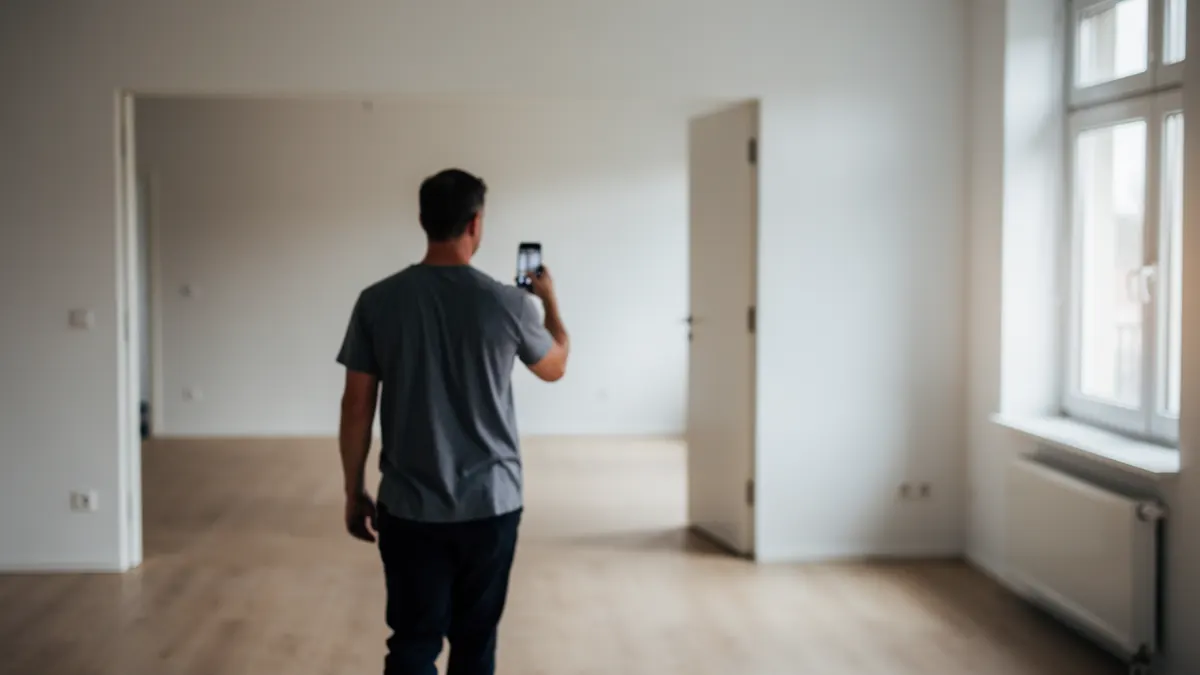
A viewing filmed on a phone converts better than a drone edit, because it answers the questions that decide whether somebody travels.
Wide angle is the central problem
That is what makes a listing false without anybody lying.
Too wide a lens enlarges rooms, pushes walls away and distorts proportions. The person who travels discovers a home smaller than the one seen on screen, and the viewing is wasted for everybody.
So film at a focal length close to the eye, walking slowly, at chest height, without exaggerated stabilisation.
And bring a person into frame at least once per room: it is the only reliable scale reference.
Show what the listing hides
Five elements that decide, and that no photograph shows.
The noise: open the window and let it run for ten seconds without speaking.
The real light at the stated time, with no added lamp.
The storage, opened.
The building: entrance, stairs, lift, parking, bins.
And the walk from the street to the door, filmed continuously.
Those shots save everybody time and attract serious rather than numerous viewings.
Renting and selling are two different videos
That is the most frequent mistake, and it costs viewings.
For a rental, the person decides fast and on practical criteria: deposit required, charges included, furnished or not, pets, length of lease, immediate availability.
For a sale, the decision is long and rests on substantive criteria: condition of the structure, year of construction, documents, ownership regime, service charges, works to plan for.
A single video trying to cover both convinces neither.
The local context counts
That is what a buyer wants to know before travelling.
The neighbourhood at the hour they would come home, the shops within walking distance, transport, school, perceived safety, parking.
So film a sequence outside, with no promotional commentary, at the most honest hour rather than the most flattering one.
What must appear in the video
A filmed listing is still a listing.
The compulsory information depends on the type of property, the regime and the status of the person publishing: the professional's identity where relevant, the property's characteristics, price and charges, and any locally required mention.
Three precautions apply everywhere. Show no documents, no number plates, no identifiable neighbours. Assert nothing about the structure, the areas or compliance without a supporting document. And keep the owner's written agreement to film and publish.
These rules depend on the state and the type of transaction, and are checked with a legal professional before publication.
What a viewing video must respect
| Point | What is needed | Otherwise |
|---|---|---|
| The mandate | The owner's written agreement | No release |
| The occupants | The consent of anyone present | Mandatory blurring |
| Privacy | Photos, mail and screens out of frame | Personal data published |
What makes a viewing understandable
A continuous route, from the entrance to the outside, in the real order. An edit jumping between rooms stops the viewer from picturing the home.
What is not said on camera
A yield, an expected capital gain, an unverified charge amount. Those belong to the official file, to be confirmed with a professional.
The creator to choose
Two simple criteria.
Somebody who knows the neighbourhood, because the questions asked in the comments will be about the neighbourhood and not the home.
And somebody able to film in one continuous take, with no editing. In this category, a cut viewing immediately raises the suspicion that something is being hidden.
Sources
Checked on 4 September 2026. Thresholds and rates change: where this guide and the official source disagree, the official source is right.