It is one of the rare categories where a video produces a visible effect within twenty-four hours: a fuller room on a Tuesday evening. Provided you film what actually decides.
The audience is a few kilometres away
That is what distinguishes this category from all the others.
A video seen by a hundred thousand people across the country is worth nothing to a restaurant. A video seen by three thousand people from the neighbourhood fills the room.
Two consequences. Choose creators who live in the area, not national accounts. And check the audience's real location before ordering, not the follower count.
Systematically add the name of the neighbourhood, the best-known landmark nearby, and how to get there. Those are the details people actually look for.
Film the dish being eaten, not plated
That is the difference between a menu image and a video that makes people hungry.
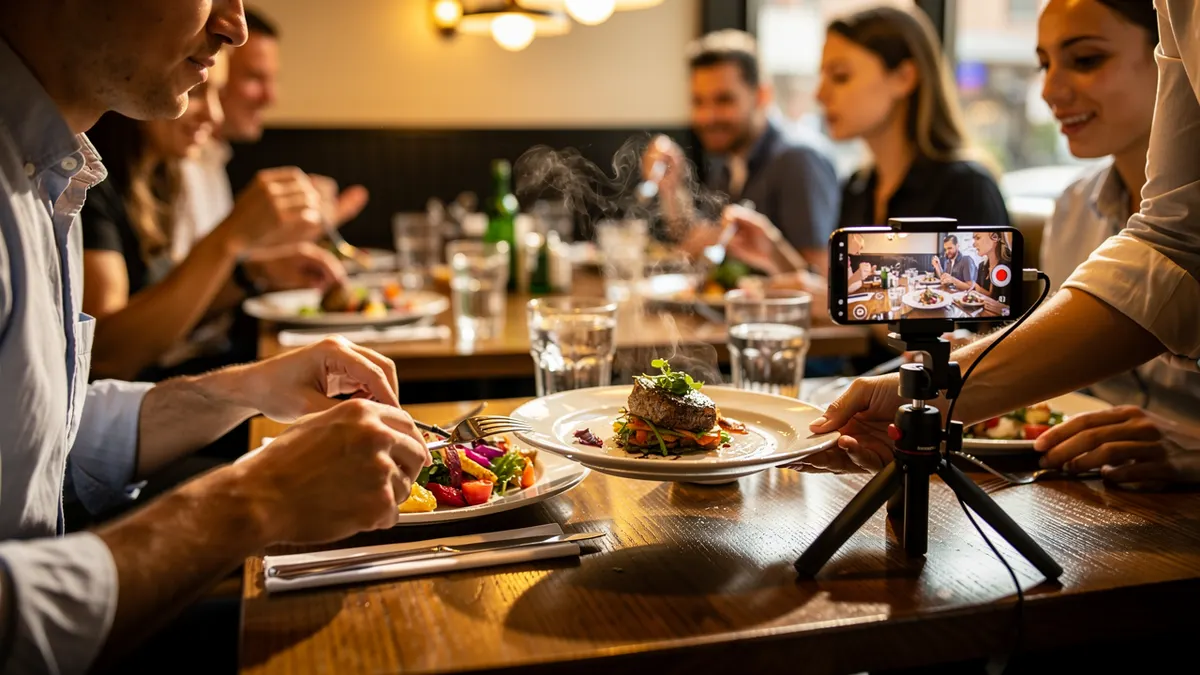
A perfectly plated, motionless dish looks like a menu photograph. What works is movement: the spoon going in, the cheese stretching, the sauce running, the steam, the first mouthful.
So film during service, with a dish genuinely destined for a table.
And keep the sound: the noise of the dish, the kitchen, the room. A dish filmed in silence loses half its effect.
The price must be visible
It is the main objection, and hiding it reinforces it.
A video showing a dish with no price produces immediate hesitation: the person assumes it is expensive, and scrolls on.
So state the price, or at least the order of magnitude, and specify what is included: drink, starter, side.
Put it as an overlay rather than in the image, so it can be corrected when the menu changes.
Work with the same creators repeatedly
It is the most profitable structure in this category.
A single visit produces a three-day peak. Somebody coming back every month becomes a landmark for their audience, and the room fills with no campaign.
So negotiate a monthly agreement rather than a one-off service, with a fixed rate and a date.
What never works
Four mistakes, all costly.
The video shot at midday in an empty room, which gives exactly the opposite impression to the one sought.
Editing too fast, where neither the dish nor the place is recognisable.
The promotion with no end date, which stays online months later.
And the absence of commercial identification, including when the creator was simply invited to eat. The rule applies to the invitation too, and is checked before publication.
What is filmed during service
| Moment | The shot | The constraint |
|---|---|---|
| The preparation | The gesture in the kitchen, close-up | Hygiene and clothing |
| The plate | From above, in natural light | Two minutes before it goes cold |
| The dining room | A wide shot with no faces | The customers' consent |
What is agreed before arriving
The slot outside service, the chef's consent, the table by the window and the list of dishes available that day. Filming during the rush yields nothing usable.
What is checked on the menu
The displayed prices, the allergens and the availability of the dishes shown. A video promoting a dish taken off the menu annoys the customer who travels for it.
The content that works all year
Three videos that do not expire, shot once.
The preparation of a signature dish, from start to finish.
The person who cooks, with their first name and their story.
And the tour of the place at a quiet hour, showing the room, the terrace, the tables, the sound of it.
Those three serve all year, and they answer the question somebody asks when hesitating to come in.