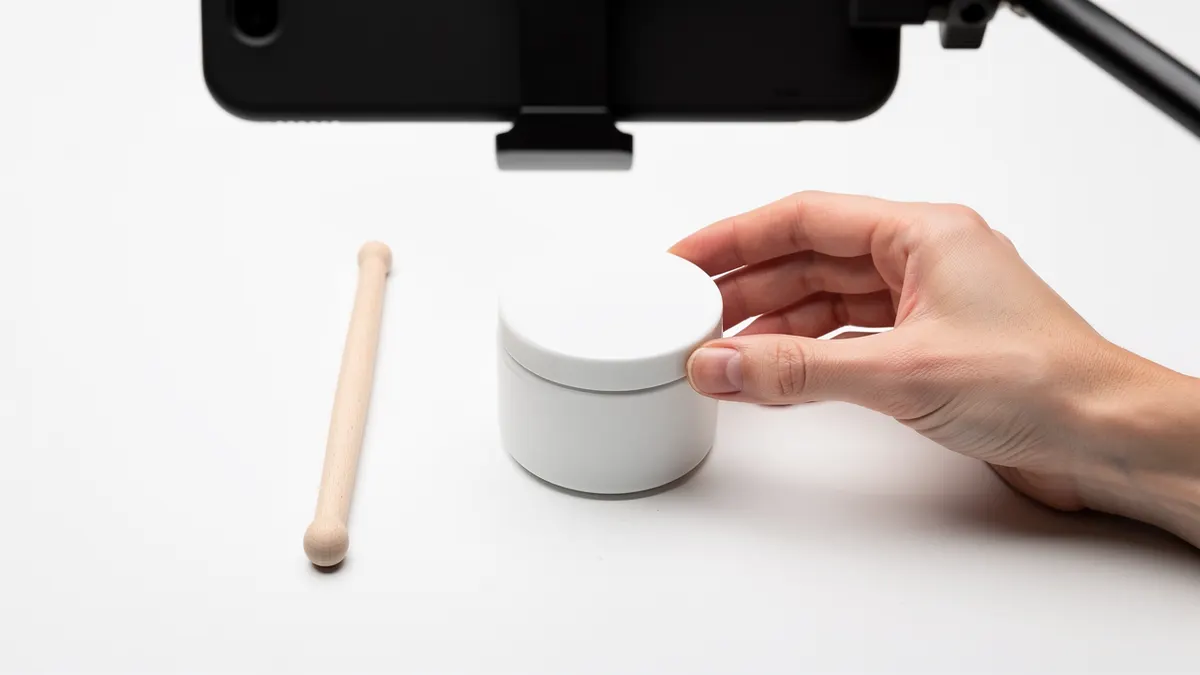
A Mercado Libre listing has three places where a video can live, and each one crops differently. That is the whole difference between a video that works there and one shot for social and uploaded anyway.
It is not a social platform with a catalogue inside. It is a catalogue with shop window rules, and the piece that wins is not the prettiest: it is the one that answers the doubt stopping the purchase before the person goes back to the results list.
The context is not a feed
Whoever watches your video is already inside a product listing. You do not have to grab their attention, you already have it: they arrived looking for exactly this and are comparing against other listings open in other tabs.
Two consequences follow, and they invert almost everything done for social. The first is that the hook in the first three seconds matters far less than the answer to the doubt. The second is that you do not have to sell the category, you have to beat the listing next door.
That is why a listing video resembles a demonstration more than a piece of content. It shows, it measures, it gives scale, it proves what a photo cannot.
The three places where the video works
On the listing
The main use and the most wasted. The person has read the title and looked at the photos: what they are missing is scale, texture, how it works and how it goes together.
What pays off here is boring and effective: the product next to something whose size everybody knows, the gesture of opening it, the sound it makes, how it looks in an ordinary home rather than a studio.
In the platform's advertising
When the piece is used to promote the listing, the context changes: now it does appear in a feed or a results list, and it competes for attention before competing for the purchase.
That calls for a second version, not the same one. Shorter, product in the first frame, and not dependent on audio, because much of that exposure happens without sound.
Outside, to bring traffic
The third is the one most often confused. A video made to bring people from a social network to the listing is an acquisition piece, and its job is not to explain the product but to give a reason to leave where the person already is.
Three pieces, three jobs. Shooting one and using it in all three places is the most common and most expensive mistake, because it fails in two of the three and nobody knows why.
What changes compared with a brand campaign
In a campaign, the brand decides the message. In a catalogue, comparison decides it: the person is looking at two or three similar listings at the same time.
That makes something important which is almost irrelevant on social. You have to show what your listing has and the one next door does not: the accessory included, the real warranty, packaging that arrives intact, the spare part.
And there is a difference in tone worth respecting. On a listing, enthusiasm works against you: somebody comparing is looking for reasons to distrust, and an over enthusiastic piece hands them one.
What to film, in order
- The product next to a reference object, to settle scale. It is the number one doubt and the cheapest to answer.
- The full unboxing, without cuts, so everything in the box is visible.
- Real use, the gesture a photo does not show: how it opens, how it adjusts, how heavy it is.
- The detail that differentiates, in close up and without music, so it can be watched twice.
Point two prevents the most returns. Most complaints are not about quality but about expectation: somebody expected something different from what arrived, and an uncut unboxing is the cheapest way to align the two before the purchase.
Who films these videos
The profile that works here is not the one for a brand campaign, and confusing them loses money on both sides.
What is needed is somebody who can demonstrate: tidy hands, a calm rhythm, the ability to explain without embellishing. No audience required, no on camera charisma required, and in many cases not even a face on screen.
That opens a door worth knowing about if you are a creator. Catalogue sellers buy volume and recurrence: they do not want one spectacular piece a year, they want ten listings solved a month. It is less glamorous work, more predictable, and priced per series rather than per unit.
The operational part is agreed beforehand and it is always the same conversation: who sends the product, who pays the shipping, whether it comes back or stays, and how long delivery takes. Four questions that prevent half the disputes in this segment.
How you know it worked
The obvious metric is the worst one. Views say almost nothing in a catalogue, because whoever reaches the listing had already decided to look.
Two signals do work and the seller already has them to hand. The first is questions: if after publishing the video the queries about size, box contents or operation drop, the piece did exactly its job. The second is returns for "not as described", the silent cost this format attacks better than any other.
Neither is measured in a video dashboard. They are measured in operations, which is why it is worth noting both numbers for the previous fortnight before uploading the piece.
There is also a third, slower and more valuable signal: reputation. A listing receiving fewer expectation complaints accumulates better ratings, and in a catalogue the rating is what decides when two listings share a price.
What does not work here
Three things recur and none survives the catalogue context.
The pure brand film, the one telling a story and showing the product at the end. On a listing nobody waits for the end: if the product is not there in the first seconds, the person goes back to the list.
The generic testimonial, saying the product is excellent without showing anything. It is the format that performs worst where people are comparing, because it adds no information the listing next door could not copy in text.
And the video with the price inside it. In a catalogue the price changes, goes in and out of promotion, and the piece goes stale without anybody touching it.
There is a fourth, less discussed and quite frequent: the video showing a different variant from the one on sale in that listing. Another colour, another size, another kit version. On a listing that is not an aesthetic detail, it is a difference between what was shown and what was delivered, and it always ends in the same place: a "not as described" complaint.
The objection you hear is that this kind of video is less striking and the brand would prefer something with more production value. True, and it is equally true that a listing is not a brand space: it is a decision space. The striking piece has its place, and it is in the other two uses, not the first.