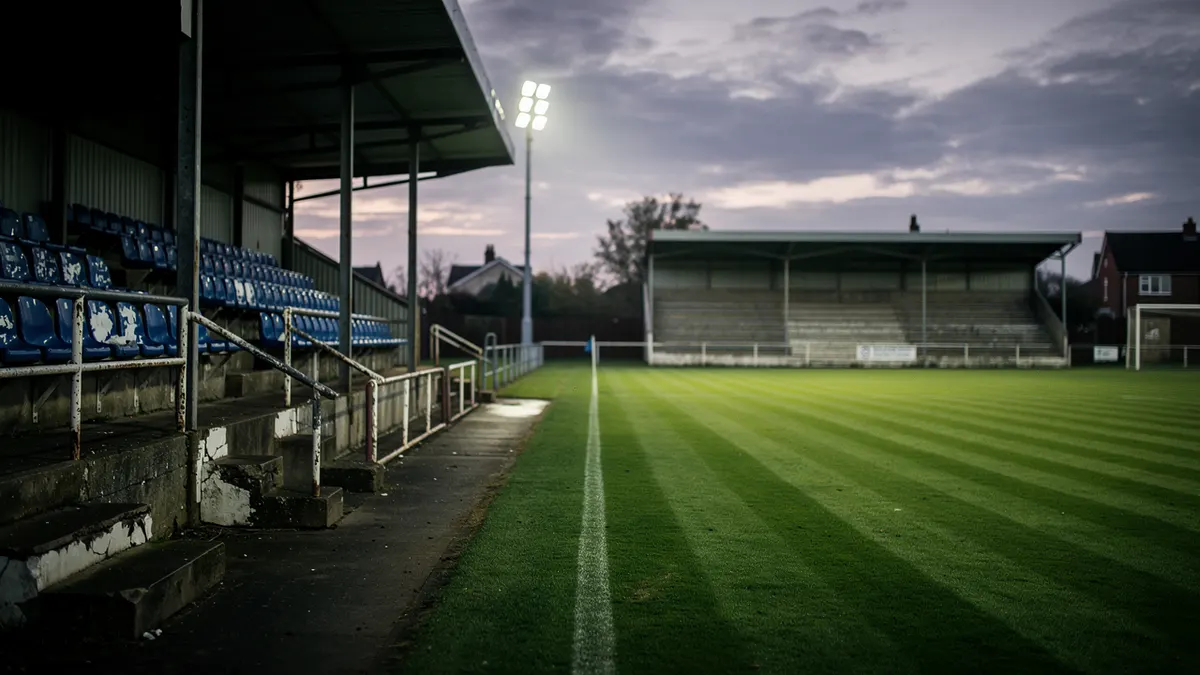
The most valuable six seconds of a football club's week belong to somebody else. Match footage is controlled by the competition and its broadcasters, and a club's own camera cannot simply put the goal on social media the way a fan expects.
That single fact ought to reshape how a club makes content, and at most clubs it does not. They spend the week waiting for the thing they cannot use, and they leave unfilmed everything they own outright.
What the club actually owns
The stadium on an empty Thursday. The kit being laid out. The pitch being cut. The programme being printed. The players arriving. The manager in the car park. The academy session. The supporter who has sat in the same seat since 1988.
All of it is the club's to film, all of it is more distinctive than a goal that will be posted by a hundred accounts anyway, and none of it requires clearing rights with anybody.
The arrival is the format nobody has worn out
Two hours before kick-off, the ground is a small city assembling itself: stewards briefed, pies in the oven, the away coach pulling in, the pitch inspected, the first fans at the turnstile. It is the same every home game and it never gets boring, because the tension of it is the actual product.
The week has two halves and clubs film only one
Matchday is the half that gets the camera. The other half is where the season is sold: Tuesday training, the community trust in a primary school, the ticket office, the commercial team walking a sponsor round the ground.
The second half is what convinces somebody who is not yet a supporter that this club is part of their town. Nobody becomes a fan because of a goal montage. They become a fan because they recognise the place or the people in it.
You are selling 23 dates, not a season
A club's commercial problem is not abstract. It is twenty-three separate afternoons and evenings, each of which has to be filled, and some of which are much harder than others.
| What most clubs post | What actually fills a stand |
|---|---|
| Season tickets on sale now | This specific fixture, ten days out, with a reason |
| Highlights the league has already posted | What the away end is like, for visiting fans |
| A generic hype video before every game | Something about the opponent this town remembers |
| Player of the month graphics | A player explaining a decision on the pitch |
| A discount in the last week | A family offer explained by the family it is for |
The right hand column is per-fixture work, and it is more content than a small club thinks it can make. It is also why the marketing budget is usually spent in the wrong place: on a season campaign that persuades nobody, instead of on the four fixtures that will otherwise play in front of empty seats.
The Tuesday night in February is the one that needs help
Every club knows which dates are hard: midweek, cold, a low-drawing opponent, a school night. Those are the fixtures worth building a film for, and they are the ones that get the least attention because they are also the least exciting to make content about.
Point the effort at the hard dates rather than the easy ones. The derby sells itself.
The academy and the community trust are the engine
Almost every British club runs a community programme that touches schools, disability sport, walking football, food banks and mental health work, and almost none of them film it properly.
That work is the strongest content a club has, for three reasons. It shows the club as a civic institution rather than a football team having a bad season. It gives sponsors something they actually want to be associated with. And it is completely unaffected by results, which means it is the only content that still works in March when the team has lost five in a row.
The one person worth filming every single week
Every club has somebody who has been there longer than any player: the kit manager, the groundsman, the steward on turnstile four, the woman who has done the tea since the eighties.
They are the club's memory, they are entirely unaffected by the league table, and they are the only person on the premises whom a supporter of forty years and a child of nine will both recognise.
Two minutes with that person, once a month, produces the content a club still has when the manager and half the squad have gone.