An aesthetics clinic in Britain sells a treatment it is not allowed to advertise to the public, because the substance it injects is a prescription-only medicine and prescription-only medicines cannot be promoted to a general audience.
That is not a technicality to work around with a nickname. It is the single fact that determines what a clinic video can be about, and the clinics that grow are the ones that stopped trying to get around it and built a format that never needed to.
The rule that shapes every aesthetics video
Advertising a prescription-only medicine to the public is prohibited. The prohibition covers the brand name, and it covers the obvious workarounds: the abbreviation everyone uses, the emoji, the deliberate misspelling, the phrase that means only one thing.
Regulators have taken action on all of those, and social media is where most of the enforcement happens, because that is where the promotion actually occurs.
What that removes from your script
The product name. Any coded reference to it. A price list for it. An offer on it. A creator saying they had it. A testimonial about the result of it. A before and after that is presented as the result of it.
What you can still say
A great deal, and this is where clinics give up too early.
You can talk about the consultation, about who is qualified to assess a face, about what a good practitioner refuses to do, about aftercare, about how to tell a safe clinic from an unsafe one, and about the entire category of non-prescription treatments you also offer.
You can say that you treat concerns, and you can describe the concern in ordinary language. The concern is not a medicine.
Before and after is not a free format here
Every other category in this corpus treats before and after as the strongest available content. In clinical work it is the most heavily constrained.
Even where a treatment is not prescription-only, a before and after is an efficacy claim, and it has to be genuine, representative, and not touched up by lighting, angle, filter or expression. Two photographs taken with different light are not evidence, and that is the most common reason a clinic image is challenged.
| What the clinic wants to post | What survives the rules |
|---|---|
| The injectable brand name and a price | The concern, named in ordinary words |
| A patient thanking them by name for it | A patient talking about the care they received |
| A dramatic before and after pair | Matched images, same light, same angle, if permitted at all |
| Book now, limited time offer | An explanation of what the consultation involves |
| A creator filming the treatment itself | A creator filming the questions they asked first |
The right hand column is not a consolation prize. It is the content that actually converts a nervous first-time patient, and nervous first-time patients are the whole market.
The claim problem is not limited to aesthetics
Dentistry, physiotherapy, private GP services and wellness clinics all run into the same wall from a different direction. Health claims have to be supportable, superlatives have to be evidenced, and the more a service promises to fix, the more precisely it has to be able to say why.
A dental practice claiming a treatment lasts a lifetime, a clinic claiming a therapy cures a condition, a supplement claiming a physiological effect: each needs evidence in hand before the sentence is written, not after it is challenged.
The practical rule for briefing is simple. If the sentence would need a study to be true, it needs the study before it is filmed.
Who should be on camera in a clinic
The practitioner, not the patient
A patient can be a wonderful subject and a terrible risk. Their consent has to be specific, informed and withdrawable, their identity is health data, and a testimonial that touches a prescription-only treatment is prohibited whatever they say.
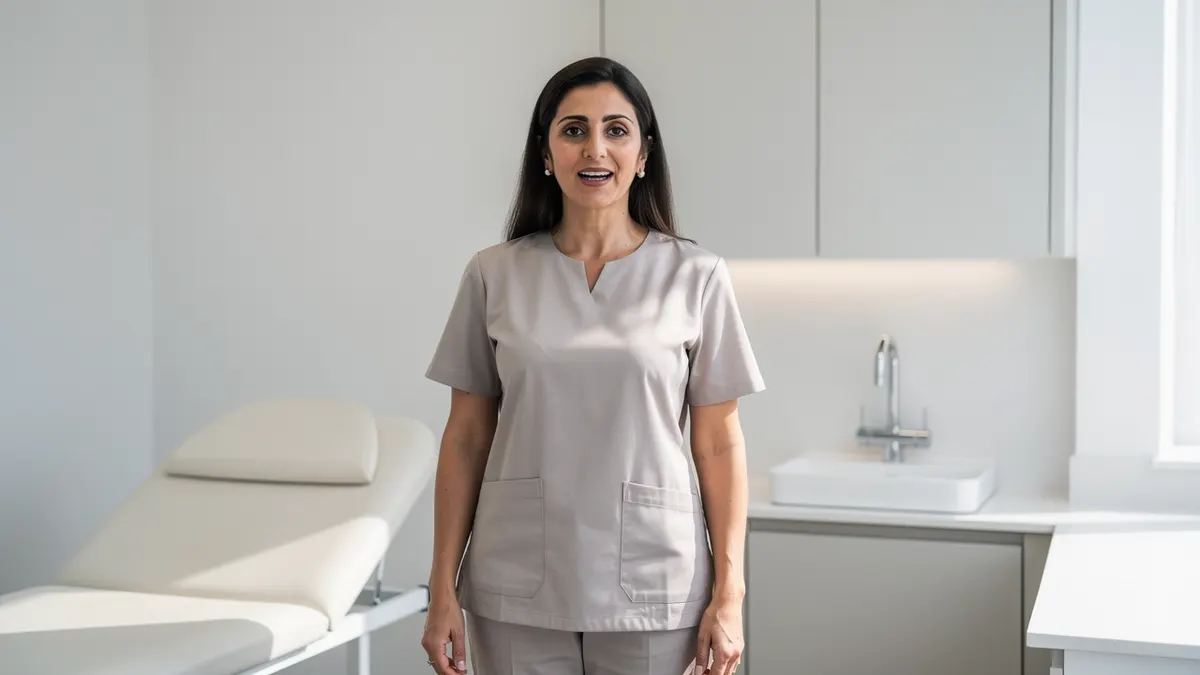
The practitioner has none of those problems and carries something the patient cannot: professional authority. In a category where the buyer's first question is whether they are safe, the person qualified to answer is the person to film.
The consultation is the content
The single most effective video a British clinic can make is an honest walk through the first appointment. What is asked, what is examined, what is written down, how long it takes, what happens if the answer is no.
It names no medicine, makes no efficacy claim, needs no patient, and answers the question that actually stops people booking, which is not how much does it cost but what will happen to me when I walk in.
The refusal is the strongest thing you can film
A practitioner explaining who they turn away, and why, does more for trust than any result ever shown. It is also entirely compliant, because refusing to treat is not a promotion of anything.
What this leaves you, which is more than it sounds
Clinics that accept the rules early end up with a content library their competitors cannot copy quickly: the practitioners on camera, the process explained, the questions answered, the standards stated out loud.
Clinics that spend two years trying to say the word end up with nothing, and occasionally with a ruling against them that stays online longer than any campaign.
The category rewards the boring, careful, named professional. That is unusual in social video, and it is why a small clinic with a good practitioner can beat a chain with a budget.
Sources
Checked on 4 September 2026. Thresholds and rates change: where this guide and the official source disagree, the official source is right.