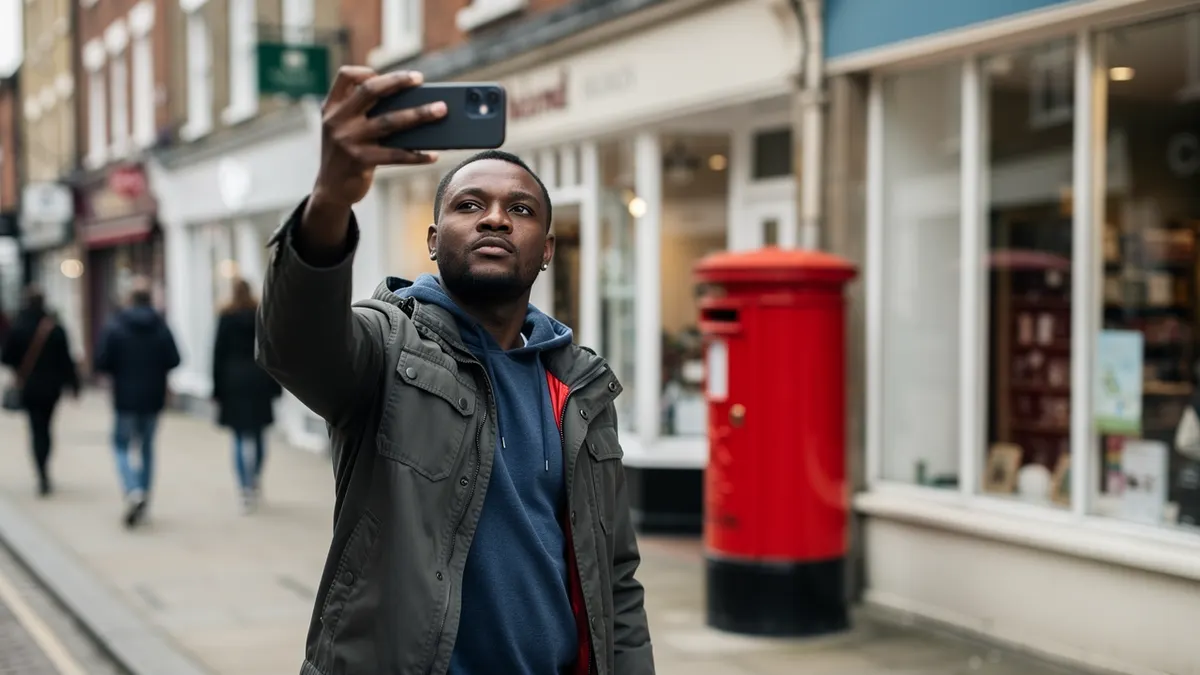
A creator sets up on what appears to be a street, films for four minutes, and is approached by somebody in a high-visibility jacket. The conversation that follows is not about cameras. It is about land.
That is the thing worth understanding before you plan a shoot in Britain, because it decides almost everything else.
The ground decides, not the camera
What is genuinely public
The public highway, which includes the pavement outside a shop, most ordinary streets, and the road itself. Council parks during opening hours. Common land. Most beaches above the high water line, and a great many town squares that have never been sold.
On genuinely public land, filming yourself with a phone is ordinary behaviour. Nobody's permission is needed to stand on a pavement and talk to a camera.
What looks public and is not
Shopping centres, indoor and out. Station concourses and platforms. Retail parks and their car parks. Canal towpaths. University campuses. Many large modern squares and riverside walkways, particularly in central London, that were built as part of a development and remain in private ownership.
Also, and this catches people constantly: the inside of any shop, café, gym, museum or venue. A door being open to the public is not permission to film inside it.
On all of those, the landowner sets the rules, and the rules are usually that commercial filming needs arranging in advance.
Asking is faster than arguing
| Where | Who decides | What to do |
|---|---|---|
| Pavement, street, council park | Nobody, in practice | Film, keep the pavement clear |
| Shopping centre or retail park | The centre management | Email the management office first |
| Station or transport property | The operator | Apply through their filming contact |
| Inside a shop or café | The manager on duty | Ask in person, at a quiet hour |
| A private square or estate | The estate management | Ask, and expect a form |
| A big set-up on a busy street | The council, and possibly police | Contact the council film office |
The right hand column is nearly always faster than the alternative, which is being stopped forty minutes into a shoot with a half-finished video and a creator who now has to come back.
The two-sentence request that works
Most refusals come from asking badly. A request that mentions a shoot, a crew, a brand or a campaign triggers a process. A request that describes what will actually happen usually does not.
What works: I would like to film myself talking to my phone for about ten minutes near the entrance, on my own, no lights or tripod, no customers in shot. Can I do that on Tuesday morning?
That is a true description of a UGC shoot, and it is a much smaller thing than the word shoot suggests to a manager who is picturing a film crew.
Filming other people
On public land there is no general prohibition on people appearing in your footage, and that is not the same as it being a good idea.
For a commercial video, anybody clearly identifiable and central to the shot should be asked. It removes a complaint, it removes a takedown request months later, and it usually improves the shot because somebody who agreed is not trying to escape the frame.
Children are the point at which caution stops being optional. Do not use footage in which a child is identifiable in a commercial video without the agreement of whoever is responsible for them, and do not film in or immediately outside a school without arranging it.
What actually gets you stopped
Not the camera. Four things, in order of frequency.
A tripod, because it turns a person into an obstruction and a filming operation. Lights, for the same reason and more so. Blocking a doorway or a pavement, which is the complaint most often made about creators. And filming staff or customers who did not agree.
Take the tripod away and half the problem disappears. Most of this corpus's advice about handheld filming exists for aesthetic reasons; in a British high street it also happens to be the difference between being ignored and being approached.
If you are approached, the useful answer is calm and short: what you are doing, that you are on your own, that you will move if you are in the way. Almost every conversation ends there. Arguing about whether the land is public is the one approach guaranteed to turn ten minutes into an afternoon.