Most creators in Britain film at home, in a room that was not designed for it. The instinct when the results disappoint is to buy something, and the thing that actually limits the picture is the room itself.
British housing has a specific set of properties that decide this: small windows, low ceilings, a single light in the middle of the ceiling, and carpet in rooms that in most countries would have a hard floor.
Find the one wall
Almost every room has exactly one usable filming position, and it is rarely the one that feels natural.
How to find it
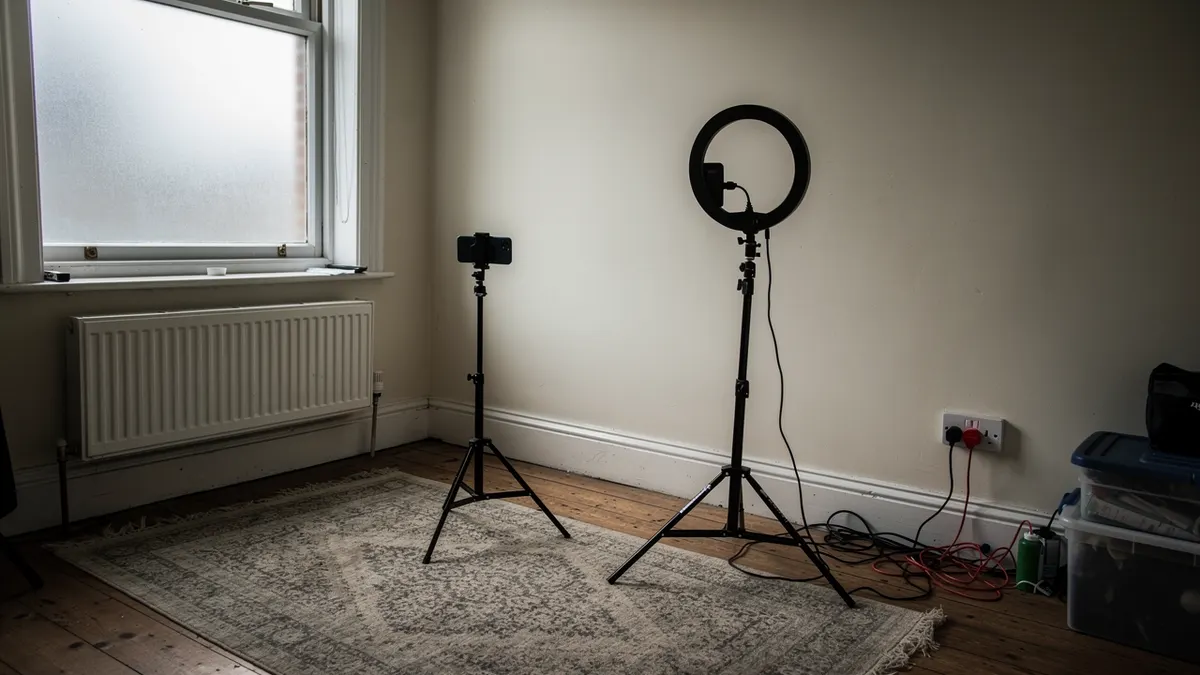
Stand where the camera would be and look at what is behind you at each of the four walls, at the time of day you normally film. You are looking for a wall that is plain, that is not opposite the window, and that has enough space in front of it for the subject to sit a metre away from it.
That distance matters more than anything you could buy. A person against a wall is a passport photograph; a person a metre off it has depth, and the background falls out of focus on its own.
What to do with the window
Sit beside it, not in front of it and not with your back to it. The window is the light, so the subject should be turned towards it at about forty five degrees, which is the single most reliable arrangement in a small room.
The ceiling light is the enemy
A British bulb in the middle of a ceiling produces the worst light available to a creator: from above, in the wrong colour, and directly onto the top of a head.
Turn it off, always, even when the room feels dark. Then either use the window, or use one small light placed at eye level to the side of the camera, matched to whatever daylight remains.
| The room says | Do this instead |
|---|---|
| Ceiling light on | Off, and use the window or one side light |
| Subject against the wall | A metre off it |
| Facing the window | Beside the window, turned into it |
| Overhead light plus lamp plus daylight | Pick one source and remove the others |
| Curtains open all the way | Half closed, to soften and to control |
Carpet is a gift
The one thing British housing gives a creator for free is acoustics. Carpet, curtains and soft furniture absorb the reflections that make a room sound like a bathroom, and a carpeted bedroom is a better sound stage than most rented studios.
What that means practically
You probably do not need acoustic panels. You need to close the door, turn off anything with a fan, and put the microphone close to the person, and the room will handle the rest.
The noise that does defeat a British home studio is not reverberation, it is the outside: traffic, a neighbour's television through a party wall, and a boiler that clicks on at the worst moment. Those are timing problems rather than equipment ones, and the fix is to record when the street is quiet rather than to buy foam.
The tidiness question
A background says something whether or not you chose it, and the two failures are opposite. A completely blank wall reads as a hostage video; a normal room with dishes and a laundry rack reads as careless.
The workable version is a plain background with two or three deliberate objects, kept permanently in place so the setup takes a minute rather than an afternoon. That consistency also makes a series of videos look like a brand rather than like a person who films wherever there is space.