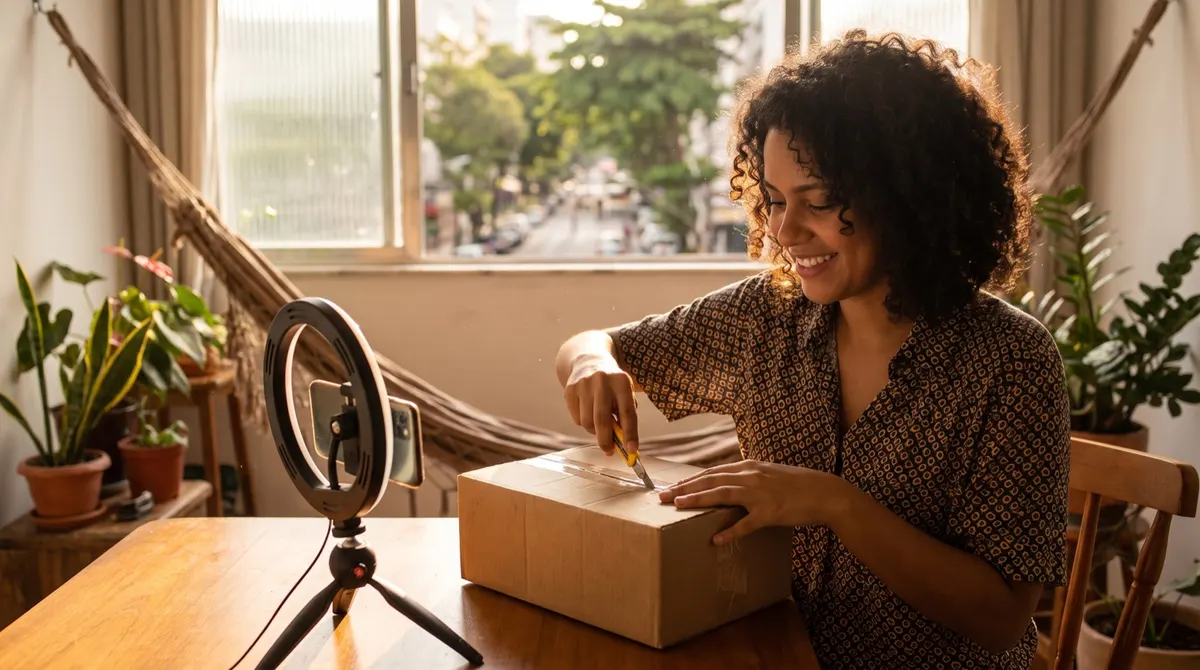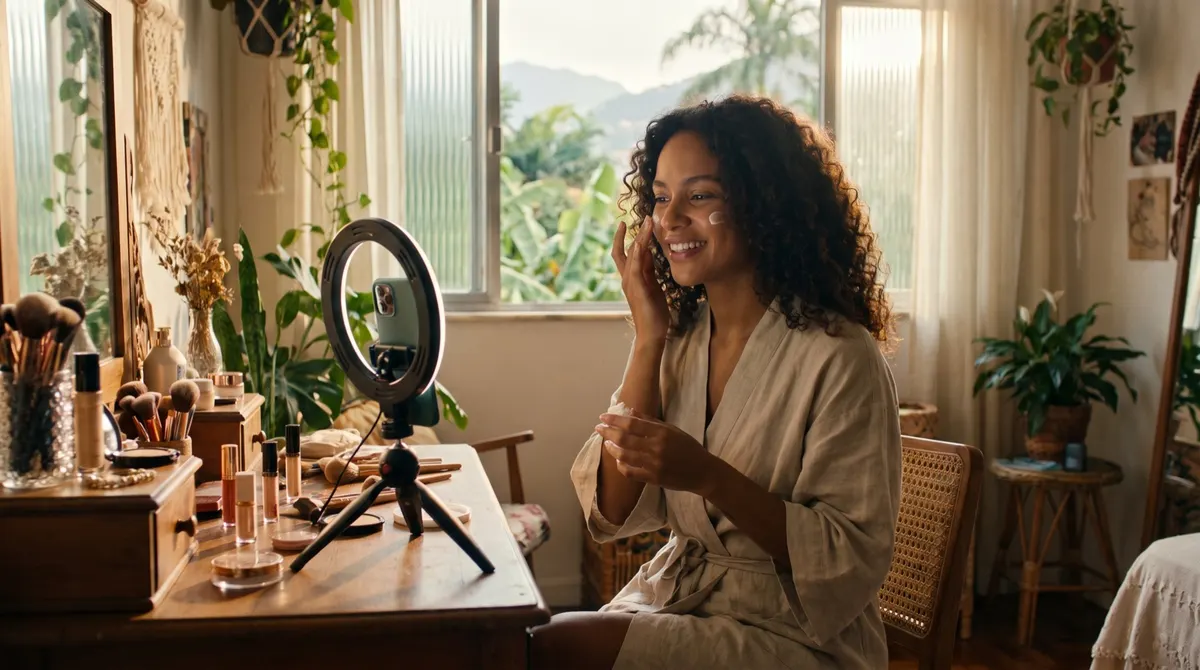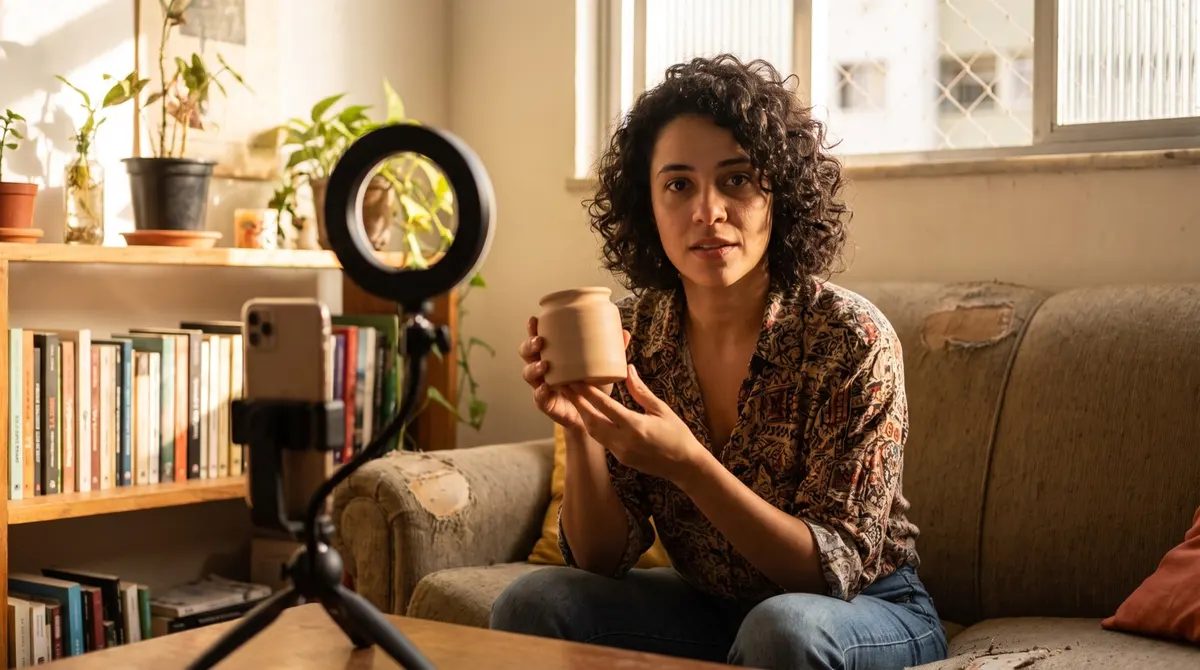
The testimonial format in UGC: authentic customer testimonials, structure, credibility and how creators get it right.
Why the testimonial converts so well here
Seven reasons specific to the Brazilian market.
Recommendation between friends is the first purchase trigger, and this format imitates its shape exactly.
The public is used to exchanging opinions in private messages, which gives the format a second life.
The market has many unknown small brands, for which social proof replaces reputation.
Buying online means taking a risk, which the testimonial reduces better than a product page.
The format is produced cheaply and adapted at will.
The country is diverse, which makes one testimonial insufficient and a series indispensable.
And a testimonial ages slowly, unlike a video built on a promotion.
The structure that works
Seven blocks, in this order.
The situation before, said in one concrete sentence, without exaggeration.
The trigger, meaning the precise moment you looked for a solution.
What you tried before, which establishes credibility in five seconds.
The product, simply named, without the brand's vocabulary.
The real use, with duration and context, dealt with above.
The result, described precisely and without superlatives.
And the reservation, what did not convince you, which is the most watched part.
What destroys credibility
Seven signals that make people leave immediately.
Enthusiasm established from the first second, before any information.
The brand website's exact vocabulary, instantly recognised.
A setting too clean for the situation described.
A vague usage duration: for a while, for some time.
The total absence of reservation, which never happens in a sincere opinion.
Eyes following a text off camera, visible in one second.
And a promise of a result the category does not allow, wording to be validated with a lawyer before the shoot.
Filming a testimonial that looks natural
Seven shooting settings.
Filming seated, at home, in the room where the product is really used.
Keeping the ambient noise, which grounds the scene better than music.
Not learning the text, only the three points to say.
Keeping the short hesitations, which are the signature of genuine speech.
Looking at the lens during the reservation, and only there.
Filming one single long take, then cutting, rather than multiplying shots.
And showing the product as it is today, opened, worn, stored where it lives.
The rules not to ignore
Six points to validate with a lawyer and with the competent authority before release.
The disclosure of advertising or commercial collaboration, whose exact form is checked.
The prohibition on presenting a paid testimonial as spontaneous.
The claims specific to regulated categories, health, food, finance, cosmetics.
The handling of the filmed person's data when it is not you.
Keeping proof of your real use, useful if the brand has to justify a claim.
And the need for written agreement before filming another person, including someone close.
The testimonial when you are not a customer
Five ways of staying honest without lying.
Saying clearly that you are discovering the product, which remains a valid format.
Talking about the category you know rather than a result you have not experienced.
Playing a part explicitly, by announcing that it is a staged scenario.
Refusing scripts that make you state an invented usage duration.
And offering the brand a real testimonial in three months, which is often accepted and better paid.
Filming somebody else's testimonial
Seven rules when the person speaking is not you.
Getting written agreement before filming, including when it is somebody close.
Asking three open questions rather than having a text read out.
Letting the person finish their sentence, even when they hesitate.
Never correcting their vocabulary, which is precisely what is being bought.
Filming in their environment, not in yours.
Showing them the edit before delivery, which avoids any later dispute.
And leaving them a written right of withdrawal, which has to appear in the licence contract.
What makes a testimonial credible
| Element | What it brings | What destroys it |
|---|---|---|
| A precise duration of use | Proof of perspective | A review shot on delivery day |
| A reservation expressed | Sincerity | An entirely positive speech |
| A recognisable context | Identification | A studio set |
What must appear from the start
The partnership disclosure. A testimonial that is paid, or obtained against a free product, remains commercial communication, and omitting it exposes the brand as much as the person on screen.
What never goes into a testimonial
An unverified figure comparison, a result promise or a health claim. Those three are confirmed with the manufacturer and a lawyer before the shoot, never after release.
Turning it into real income
Seven steps for making this format a regular activity.
Building a series of testimonials on products you genuinely use.
Specialising in one category, which makes your testimonials more credible and better paid.
Systematically offering a long and a short version.
Recording several wordings of the same key sentence, much appreciated in advertising.
Invoicing production and rights separately, with a written duration.
Planning the three-month follow-up, which is the genuinely rare product in this format.
And keeping a record of your purchases and uses, because credibility here is proved with dates.
One last marker: in Brazil the testimonial that converts is not the one that promises most, it is the one you could send to a friend without feeling awkward. Test every video with that question before delivering it, and half the credibility problems disappear.