Belgium has a dense furniture and interiors industry, from long-established manufacturers to designers and a large number of independent showrooms. It sells a product that people consider for weeks and then buy in person, which makes it unlike almost everything else UGC is used for.
The decision is not made in front of the object. It is made in the buyer's head, in a room they are trying to picture, and video either helps them picture it or it is decoration.
Nobody buys a sofa, they buy a room
A customer standing in a showroom is doing arithmetic: does it fit, does it work with the floor, will it look absurd next to the window, will two people actually be comfortable on it.
What that means for a shot
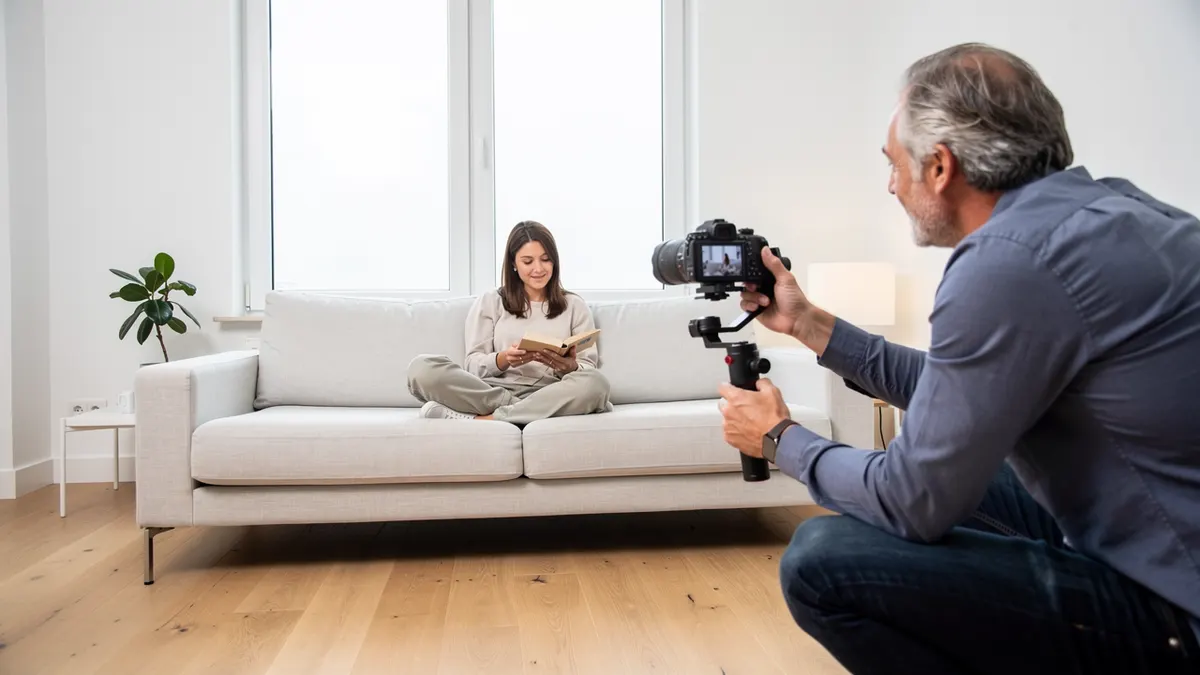
Film the object in a room with recognisable things in it. A chair beside a door, a table with a laptop and a cup on it, a sofa with a person sitting normally rather than posing. Those references are what let a viewer transfer the object into their own space.
The empty white background, which is the default in this category, removes every reference and therefore removes the only thing the buyer was looking for.
Scale is what photography loses
A still image can be beautiful and completely uninformative about size. Video can solve it in two seconds with movement, which is the strongest argument for using it here at all.
How you show it
Walk past. Sit down. Open a drawer with a hand in the frame. Put a hand on a surface. Any human body in relation to the object tells the viewer more about dimensions than a diagram, and it costs nothing to film.
The other half is material. Texture reads through movement and grazing light: a hand across linen, a finger on a joint, light passing along a brushed edge. That is also where a quality difference between two products becomes visible, and it is the argument a cheaper competitor cannot copy.
The showroom is a lighting trap
Showrooms are lit to sell, not to film. Warm spotlights, mixed sources, reflections in glass, and often a low overall level that pushes a phone into noise.
What to do instead
Film near the largest window in the building, turn off the spots in the area you are shooting, and bring one light you control rather than trying to overpower the ceiling. If the room genuinely cannot be fixed, film the product somewhere else: a client's home, an empty office, a corner of the workshop.
The other habit worth having: shoot in the morning before opening. Showrooms are quiet, the staff are available, and the mixed evening light that ruins colour is not there yet.
What each buyer needs to see
| Buyer | What decides it | The shot that does the work |
|---|---|---|
| A private customer | Scale and comfort | A person using it normally, in a real room |
| An interior designer | Materials, finishes, options | Close-ups of joints, fabrics, edges |
| A retailer | Range coherence and delivery | The collection together, plus packaging |
| An office or project buyer | Durability and configuration | Repetition, modularity, a busy space |
| A visitor to a trade fair | Something to remember it by | One short, striking loop with no words |
The fourth row is the one furniture brands underuse. Contract and project buyers are a large share of the market in this country and are almost never served with anything except a PDF.