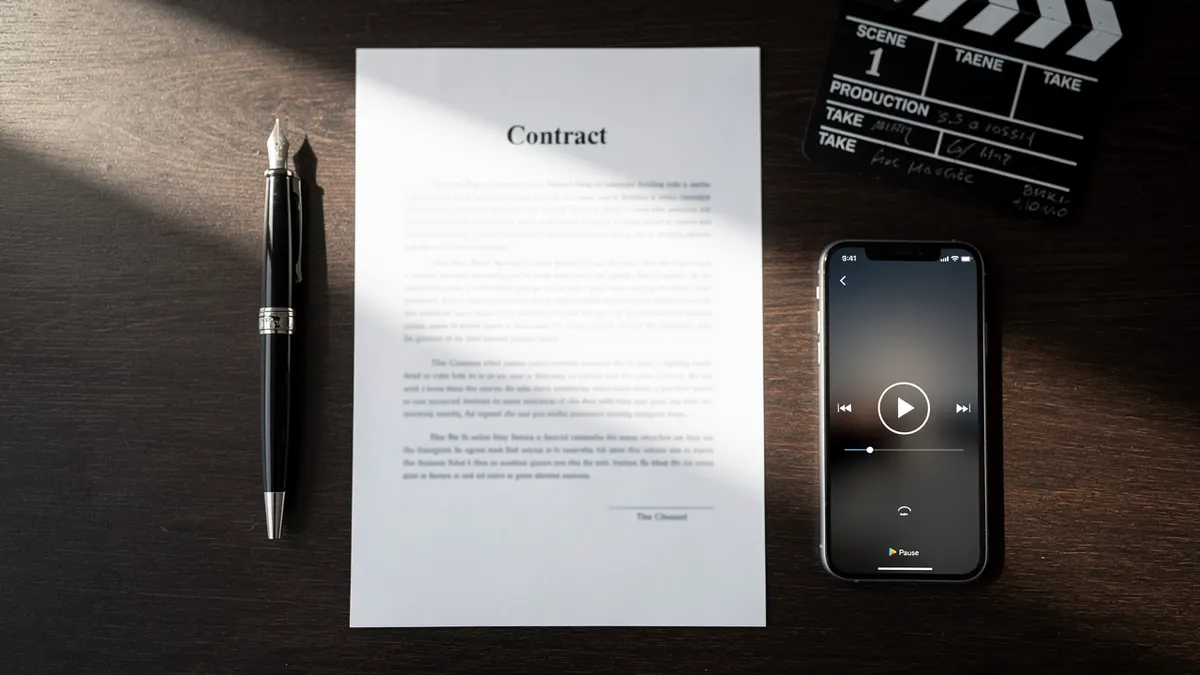
French law requires a precise assignment: which rights, which media, which territory, for how long. A vague formula protects nobody.
The four compulsory elements
Four mentions, all necessary, and none deduced from the others.
The rights assigned: reproduction, representation, adaptation, each named separately.
The media: social networks, paid advertising, website, product listing, display, each listed.
The territory: the countries concerned, written in black and white.
And the duration: an end date, never an open formula.
One practical consequence: those four lines fit in one paragraph, and they protect both parties far better than a ten-page contract drafted elsewhere.
Your image is a separate right
Three elements often confused, and legally separate.
Copyright on the video, which concerns the work.
The image rights of the person filmed, which concern their person.
And the right over the voice, which follows a close logic.
One direct consequence: assigning copyright gives no permission to use the face or the voice. A separate written authorisation is required, with its own duration, its own territory and its own media.
One frequent and badly handled case: visible people other than the creator, a child, a relative, a customer. Each requires a separate authorisation, signed on the day of the shoot.
What else has to appear in a contract
Five points, all useful.
The precise description of the service: number of videos, length, formats delivered.
The price, and exactly what it covers.
The permitted modifications: recropping, subtitling, dubbing, re-editing. Each is mentioned, because adapting a work is a separate right.
The fate of the files at the end: deletion, renewal, renegotiation.
And the number of revisions included, which avoids half the later disagreements.
One important clarification: a moral right exists independently of the economic assignment. It cannot be assigned, and it implies in particular respect for the work. Its exact scope is checked with a lawyer.
What a creator can refuse
Four frequent requests, all debatable.
Assignment with no time limit, incompatible with the requirement of delimitation.
Free use of their face in edits they will never see.
The right to modify without agreement, including making them say something else through dubbing.
And unpriced sector exclusivity, which closes off months of work with no compensation.
One balanced note: those requests are not illegitimate. They have a price, and that price is discussed before signature.
The four boundaries any assignment must carry
| Boundary | What it fixes | Common flaw |
|---|---|---|
| The object | The exact files assigned | A vague phrase covering the whole shoot |
| The media | Social, paid ads, website, in-store | One catch-all word |
| The territory | The countries of release | Worldwide with no reason |
| The term | An end date | A perpetual assignment |
What stays with the creator regardless
The right to be credited and the right to object to a change that distorts the video. Those are not for sale.
What is reread before signing
Automatic renewal, sub-licensing to third parties, and the exclusivity clause barring competitors. Each is priced separately, to be confirmed with a lawyer.
The practical reflex
Five lines in the purchase order, and the essentials are covered.
Rights assigned, listed.
Media, listed.
Territory.
Duration, with an end date.
And an image authorisation signed separately, with the same end date.
One habit worth a contract: name the files with the rights end date. The day somebody tries to reuse a video two years later, the information is in front of them.
One last marker, valid on both sides of the table: a precise contract is not a sign of mistrust, it is what allows working together again. Disputes in this sector almost never arise from bad intent, but from a sentence each side understood differently.
Sources
- Urssaf, official auto-entrepreneur portal
- Service Public, how to become a micro-entrepreneur
- Service Public, crossing the micro-entrepreneur turnover thresholds
Checked on 4 September 2026. Thresholds and rates change: where this guide and the official source disagree, the official source is right.