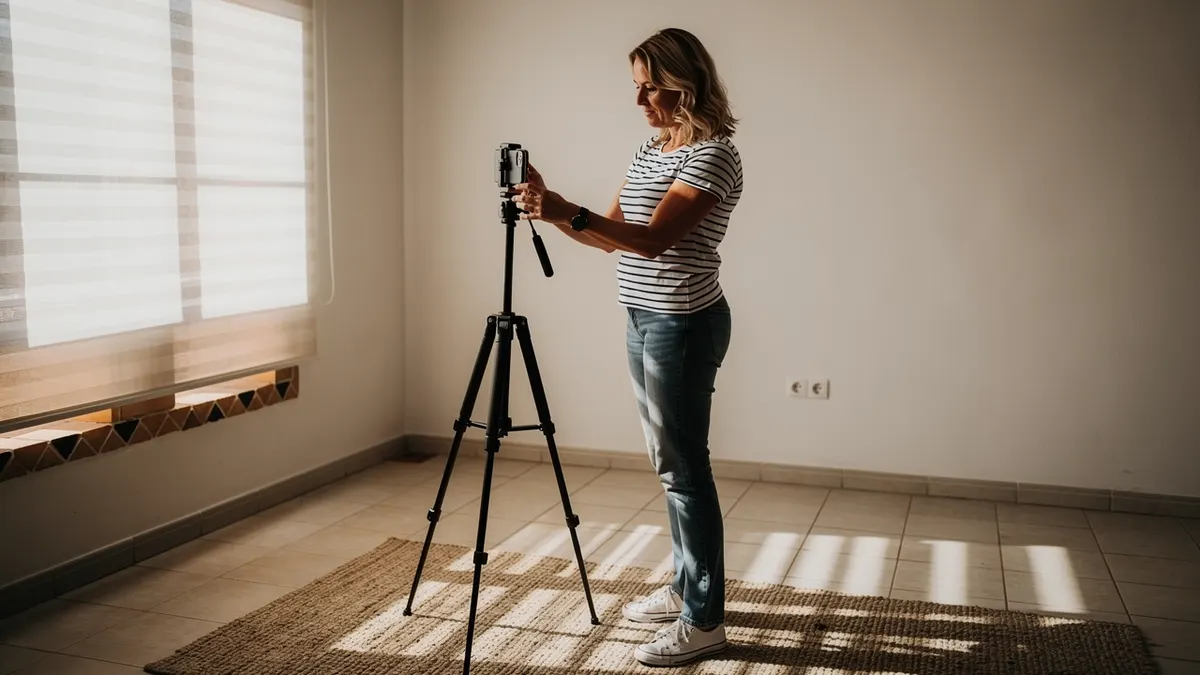
Setting up in a flat with shutters and tiled floors, handling heat and noise, and the corner that always works.
Choose a corner and keep it
Three reasons never to change it.
Consistency of image becomes a signature: brands recognise your setting.
Settings are not redone: height, distance and exposure stay identical from one order to the next.
And joins become possible: you can reshoot a shot weeks later without it showing.
Once the corner is chosen, mark the tripod position with tape and note the ideal hour. Those two pieces of information save twenty minutes on every shoot.
Shutters, your best ally
Three uses, according to the time of day.
At midday, when the light is violent: close almost completely and keep a thin opening, which produces a soft, directional light.
In mid-afternoon: open halfway and place yourself at forty-five degrees from the window.
And at the end of the day, when the light turns orange: either you embrace it, or you compensate with a neutral source, but do not mix the two.
One frequent mistake: filming with your back to the window. The face goes dark, and no setting recovers it.
The tiled-floor echo
Four gestures, from the most effective to the most discreet.
Bringing the microphone closer: twenty centimetres are enough to reduce the reflected share of the sound.
Laying textile on the floor, out of frame.
Speaking away from the walls: one metre already changes a lot.
And avoiding empty rooms: a furnished bedroom sounds better than a spacious living room.
One simple test before shooting: clap your hands once and listen. If the clap lingers, the room is not ready.
Heat and noise
Four constraints specific to this climate and these homes.
Air conditioning and fans are audible: they go off during takes, which means shooting in short sequences.
Open windows bring in street noise, particularly in the evening and at weekends.
Make-up and skin change with the heat: film the face shots first.
And the hottest hours are often the quietest outside, which partly compensates.
One arrangement settling almost everything: shooting early in the morning. The light is soft, the street is silent, the room has not warmed up yet.
The small space, solved
Three tricks costing nothing.
Moving the camera back rather than the subject: it is the distance to the lens that gives the impression of space.
Filming a corner and not a wall: depth comes from the diagonal.
And using the open door as a background: it adds a second plane without adding square metres.
One note on credibility: do not empty the room. Two or three real objects make the image alive, and that is exactly what brands look for in this format.
What can be fixed in an ordinary room
| Problem | The cause | The corrective move |
|---|---|---|
| Echoing sound | An empty room | Film in a furnished room |
| Tinted skin | A coloured wall | Step away from the wall |
| A busy background | Too many objects | Two metres of clear wall |
What is set up once and kept
A corner of the room marked on the floor, a lamp always in the same place, and a neutral background. That fixed set saves twenty minutes on every shoot.
What is checked before each take
The direction of the light, the mic level, the absence of personal objects in frame and of reflections in a window. Thirty seconds that avoid a full reshoot.
Three corners of a home and what they give
| The spot | What it allows | Its condition |
|---|---|---|
| The table near a window | Product and hand shots | A side window, not behind you |
| A plain light wall | The piece to camera | A tidy background, no reflections |
| The kitchen worktop | The gesture and the preparation | A clean, clear surface |
What most often fails at home
The sound. A fridge, a street or an empty room ruins a decent take, and recording in a furnished room with the doors shut corrects more than any mic bought afterwards.
What to prepare before switching the camera on
Tidying the frame and the background. A personal item in shot, a legible letter or a family photo makes a video unpublishable, and checking takes two minutes against a full reshoot.
The real minimum equipment
Four purchases, in this order of priority.
A wired lapel microphone, which changes the result more than any camera.
A tripod, even a cheap one.
A single lamp with a dimmer, for evening shoots.
And a folding reflector, or failing that a large white card.
One last marker, valid for everybody: what distinguishes an amateur video from a professional one is almost never the camera. It is the sound, the stability and the consistency of the light, that is to say three things you set once and that then hold for months.