A high-value sale decided on trust, not on watts. What a creator can promise in savings, and what gets you reported.
What a creator cannot promise
Five statements to set aside.
A percentage saving on the bill, which depends on consumption, roof orientation, region and contract.
A payback period, a calculation belonging to a personalised study.
A production performance, varying from one installation to another.
A subsidy amount, dealt with above.
And any figure-based comparison with a competing supplier not resting on a documented study.
What remains possible: describing your own installation, saying what you paid, showing your bill before and after as a personal experience, and referring to a free study for everything else.
Subsidies change, the video stays
Four practical consequences.
Every video in this category must carry a visible date.
The edit must isolate the dated elements in separate shots, easy to replace.
A rapid removal procedure must exist, applicable within hours.
And archiving the published versions, with their figures, protects in the event of a challenge.
What really has to be filmed
Five contents, from most effective to least.
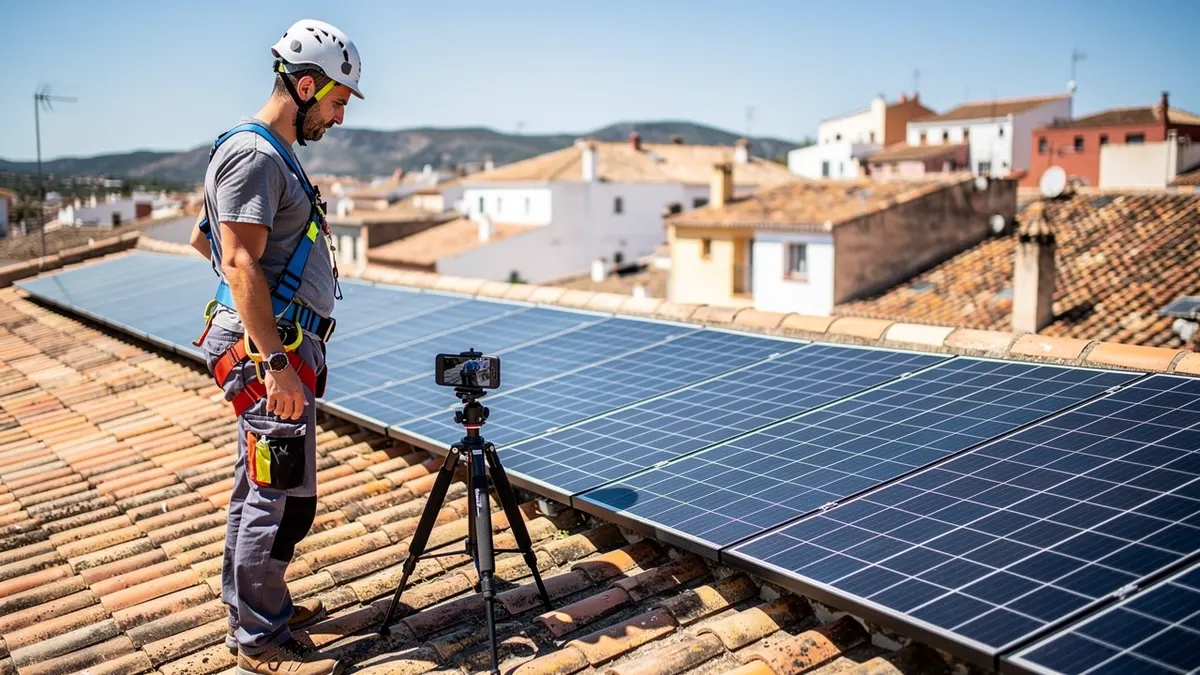
The technical visit and the installation, filmed continuously, answering the question of disruption and how long the work takes.
The household's real bill, before and after, shown as a particular case and not as a promise.
The production tracking on the app, a year apart, with the weak months shown as much as the good ones.
Maintenance: what has to be done, how often, and what it costs.
And after-sales service: who comes, in how long, what is guaranteed.
One note: in this category, showing a mediocre month raises credibility more than any sales argument.
The most frequent technical doubt
Four questions that block the decision, each to be handled in a short video.
What happens at night and on overcast days.
What becomes of the surplus produced and not consumed.
What happens in the event of a grid outage.
And what happens to the installation on moving house or selling the property.
The case of the apartment block
Three distinct situations, often confused.
The individual home, the simplest case.
The co-owned building, which supposes a collective decision and a long timetable, a subject nobody makes content about although the audience is looking for it.
And renting, where the installation belongs to the owner, which entirely changes the reasoning.
One editorial consequence: content aimed at co-owned buildings has the least competition in the category, because it requires knowing the decision process rather than the technology.
What is shown without ever quantifying
| On screen | What you say | What you do not say |
|---|---|---|
| The rooftop install | How the fitting unfolds | A payback period |
| The monitoring app | The interface and its use | A promised annual output |
| The equipped home | How the residents feel | A saving on the bill |
What is filmed and genuinely reassures
The support: the technical survey, the quote explained, the grid connection, and after-sales you can reach. That is what nearly every video in this sector lacks.
What is verified before each claim
An installer certification, a warranty, a public subsidy or a feed-in rate. Each is confirmed with the competent authority and dated, because they change.
Which creator to engage
Four profiles that work.
The household equipped for at least a year, the only one able to show real data.
The installer, for the technical part, with the professional responsibility that entails.
The home and renovation profile, whose audience is already planning work.
And the budget and household savings profile, which reaches the audience at the right moment.
One last marker: in this category the video that sells is not the one promising a saving, it is the one showing an ordinary installation, a year on, with its good and bad months. The promise drives people away; the real data gets an appointment booked.