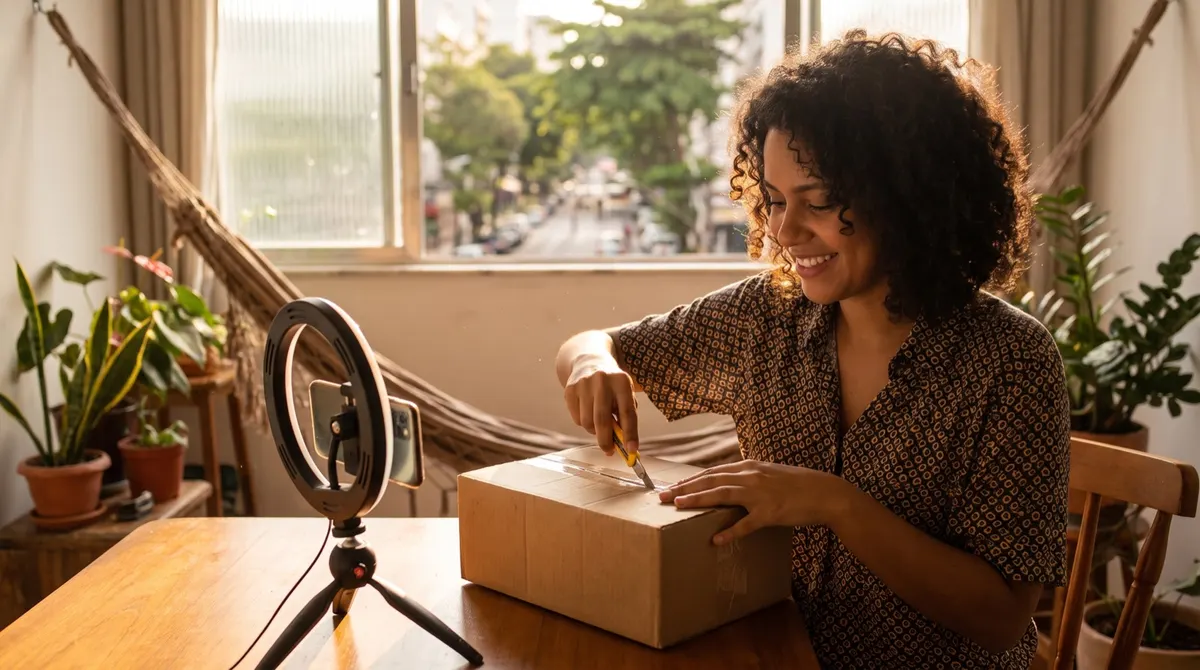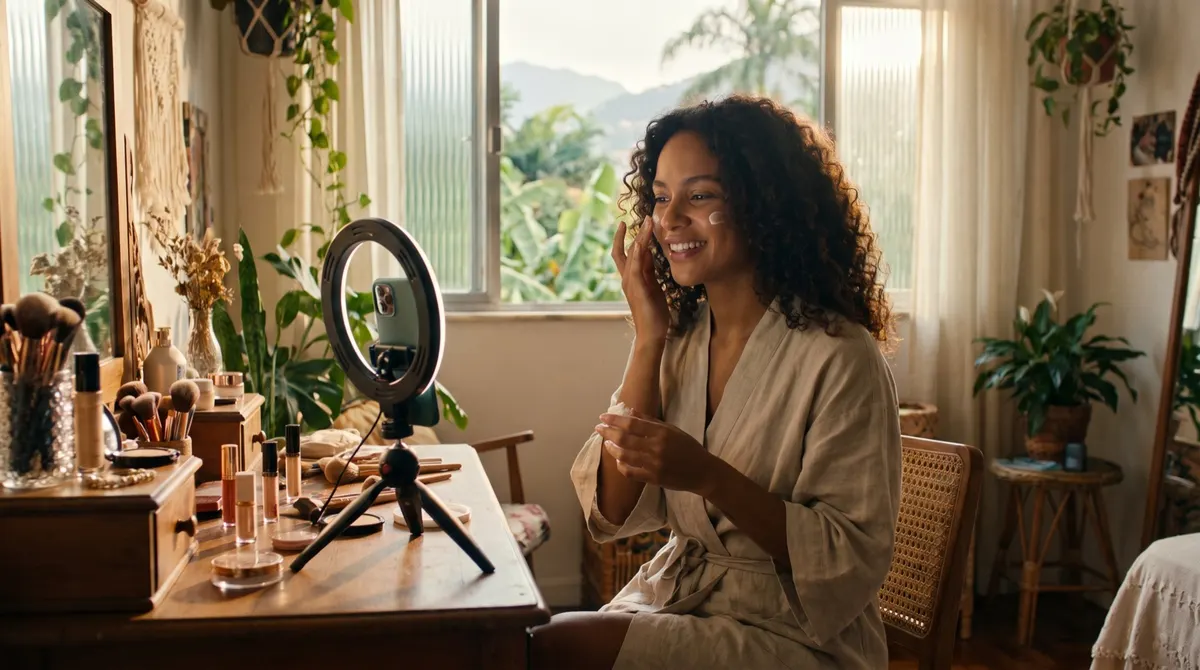
The Get Ready With Me format in UGC: structure, speaking naturally, product integration and how Brazilian creators succeed.
Why brands love this format
Six reasons, all measurable.
Watch time is high, because the viewer wants to see the result.
The product appears in a situation of use, not in presentation.
The format supports several products without becoming a list, which is rare.
It works in every category: beauty, fashion, home, food, sport.
It varies easily: morning, evening, going out, work, an event.
And it creates a closeness that extends the content's life long after the campaign.
Structuring your video
Seven steps, with their function.
The visible starting point: the initial state, with no staging.
The stated constraint: the time available, the destination, the weather, which creates the stake.
The progression, through successive gestures, in the real order.
The product, placed at its moment, dealt with above.
The setback: something does not go as planned, which makes the sequence true.
The result, shown once and without insistence.
And the close, which says where you are going, giving meaning to the whole video.
Speaking to camera naturally
Seven techniques that remove the recited effect.
Speak while doing, never staring at the lens between two gestures.
Accept hesitations: they prove nothing is being read.
Use short sentences, the kind you say to somebody in the room.
Ask a question out loud and answer it yourself, which creates a conversational rhythm.
Keep the real noises: water, drawer, brush, doors, which establish the place.
Avoid the opening greeting, which consumes the attention window.
And redo the first sentence three times at the shoot, keeping the third take.
Integrating the product without breaking the mood
Six practical rules.
Place it at its logical moment, dealt with above.
Name it once, distinctly, rather than three times insistently.
Show the real gesture: the quantity, the texture, the way it is applied or put on.
Say one precise, verifiable thing: the smell, the sensation, how it holds after a few hours.
Do not interrupt the routine to make a demonstration: the demonstration is the routine.
And keep the mandatory commercial mention, whose arrangements are checked with the competent authority, without making it a break in tone.
Rhythm and light that hold attention
Seven settings that change retention.
One camera position for the whole thing, plus only one or two close shots.
The phone on a support, never hand-held for a long sequence.
Natural light from a window, the same from start to finish, which avoids visual breaks.
Clean cuts between gestures, with no worked transitions.
A speed-up on long passages, keeping the real sound over it.
A cutaway prepared for every planned removal.
And a total duration suited to the medium: thirty to forty-five seconds for advertising, two to four minutes for organic.
What the format lets you show
| Moment | What it sells | Length |
|---|---|---|
| Choosing the outfit or the product | The hesitation, hence credibility | 6 s |
| Applying or putting it on | The real gesture | 12 s |
| The result, head to toe or face on | What it looks like | 6 s |
What makes this format work
Real time. You watch someone getting ready, so the product appears within a use, never presented head-on. That is what separates it from an ad and makes it watchable.
What makes it fail
Too fast an edit, perfect light, and a recited script. Those three turn a getting-ready into a spot, and the viewer scrolls on.
What gets a delivery refused in this format
Five frequent mistakes.
The product presented in the first second.
A visibly re-staged routine, with a too-tidy setting and too-perfect light.
Three different brands cited in the same sequence, which cancels the effect.
A duration exceeding what was ordered, forcing the brand to cut it itself.
And the absence of cutaways, which makes any clean shortening impossible.
One last marker: in this format the brand is not buying a demonstration, it is buying a place in a real routine. The product arriving at the right moment is noticed without being displayed; the one arriving too early is seen and skipped.