If you are a brand abroad and want to work with Argentine creators, the creative part is the easy part. What decides whether the relationship works is the payment circuit and the invoice, and that gets settled before the first delivery or it never gets settled at all.
This is not a country by country rate comparison. It is what has to be agreed so that a creator in Argentina can invoice you, get paid without surprises, and work with you again the following month.
First: the invoice
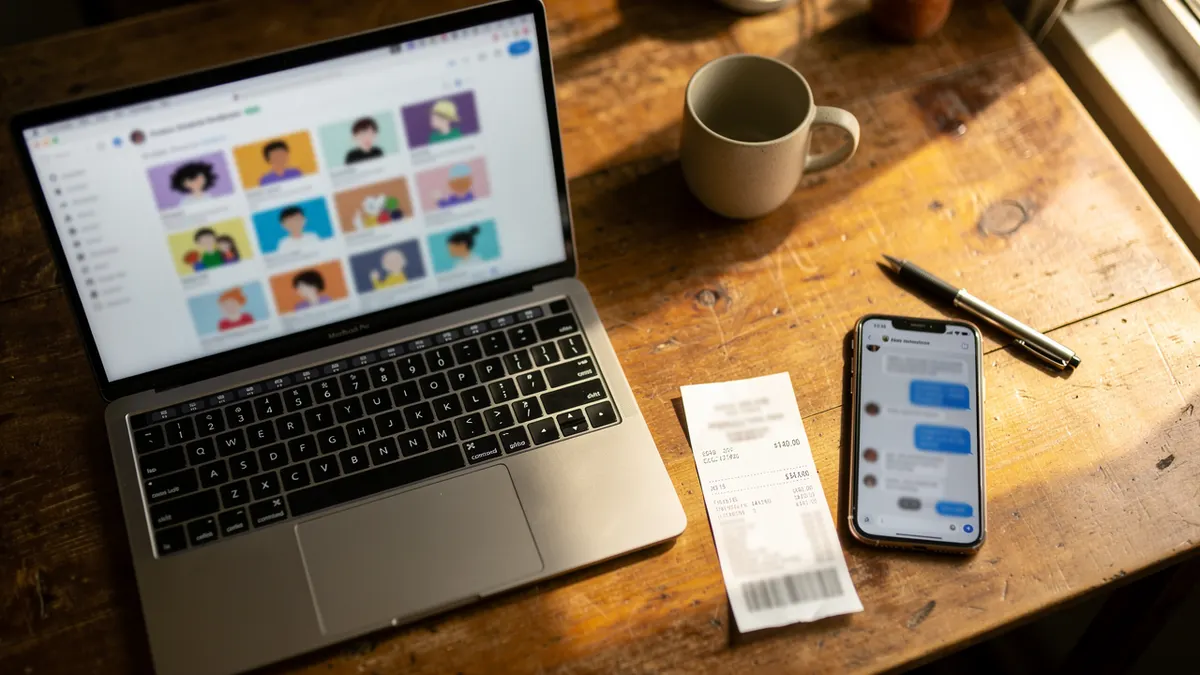
An Argentine creator invoicing a company abroad issues a different document type from the one used with a local client. It is not an administrative detail of theirs: it is what will reach you, and what your accounts team will have to process.
Two questions follow, worth asking in the first message, before discussing price. Whether the creator already invoices abroad, because somebody doing it for the first time has a procedure to sort out and that adds time. And what detail they need from your side to issue it, because it is usually the full legal name and registered address of your company, not the trading name.
Asking this at the start is not bureaucracy. It is what avoids the most common situation in this kind of relationship: work delivered, approved, and the invoice stuck for three weeks because a field is missing.
Currency, and who absorbs what
There are three separate decisions here that tend to be treated as one, and separating them avoids most of the arguments.
Which currency the price is agreed in
The usual and sensible thing is to agree in the buyer's currency, the one that does not move for you. The creator is already used to quoting that way, and it is simpler for them than a conversion done on your side.
What is worth avoiding is agreeing in one currency and paying in another without saying what reference converts it. It is the most frequent source of argument and the easiest to remove: one line with the currency and the moment of conversion.
Who pays the transfer costs
They are not negligible and not always visible in advance: if nothing is said, the creator discovers them when less than the agreed amount arrives, and that is a poor way to start.
There are two clean ways to settle it and neither is better: either the price is net to the creator and you absorb the costs, or it is gross and they do. What does not work is not saying.
What counts as payment made
For you it may be the day you ordered the transfer; for the creator it is the day the money is available. There can be a week between those dates, and the contract should say which one counts.
It matters more than it seems with chained deliveries: if the second piece depends on payment for the first, that definition sets the campaign's real calendar.
What changes compared with hiring locally
Not much creatively, and quite a lot operationally.
The product has to arrive, and that is almost always the real bottleneck. Before fixing dates it is worth knowing whether you will ship from abroad, whether you have local stock, or whether the creator can buy it and you reimburse them, which is usually the fastest route and the one touching customs least.
Rights are written differently. An assignment designed for local use says nothing about your market, and if the piece is going to be shown in your country, the territory has to be named. It is one line and it avoids the most expensive complaint.
And the time zone works in your favour, which is not always exploited: with Europe there is a morning overlap and with North America an almost complete one, so revisions get resolved the same day instead of losing cycles.
There is a fourth point worth anticipating and almost never in the brief: the language of the piece. If you need the version in your language, say so before the shoot and not after, because it changes the script and sometimes changes who can do it. Many Argentine creators work comfortably in neutral English and others do not, and that is a casting question, not an editing one.
The cheapest variant, when the budget is short, is to shoot in Spanish and deliver with open subtitles and a clean audio track. It allows dubbing later without reshooting, and it is the decision that buys the most flexibility for the least money.
If the piece is going to run as an ad from your account
Running the video as an ad from your brand account is one thing; publishing it from the creator's account with your spend behind it is another, and the second needs a permission the licence does not include.
That permission is granted from the creator's account, through the platform's own tools, and it is independent of the contract: the advertising use can be assigned in writing while the technical access to run ads is still missing. They are two separate steps, and they get confused on exactly the day the campaign has to go live.
Three things are worth knowing before building the calendar. The permission has its own expiry date, which almost never matches the contract's. It is granted per ad account, so if your agency moves account it has to be requested again. And it is revoked in one click on the creator's side, which in practice means the relationship matters for as long as the campaign is running.
None of this is specific to Argentina. What changes is the cost of sorting it out late: with a time difference and someone who has no reason to be available at your hours, a missing permission on launch day gets resolved the following day.
How to set up the first collaboration
- Ask for the invoicing details before agreeing the price. If that works, everything else works.
- Agree currency, transfer costs and which date counts as payment. Three lines, once.
- Settle how the product arrives, with a confirmed date, before fixing the shooting date.
- Name the territories of use in the contract, including yours. Do not leave it blank or put "worldwide" out of habit.
Point one looks like a strange order and it is deliberate. A relationship that jams at invoicing is not recovered by a good piece, and discovering it after approving a budget is the most expensive way to find out.
What not to do
Paying through informal channels to avoid the invoice. It creates a problem for the creator, leaves you without accounting support, and guarantees the relationship will not repeat.
Promising volume to lower the initial price and then not bringing it. It works once and burns the contact in a market where creators know each other.
And assuming that what your market allows you to say can be said here in the same way. What is claimed in the piece is governed by the rules of the place where it is distributed, and if the piece also runs in Argentina there is a local framework that applies.
The reasonable objection on your side is that this looks like a lot of coordination for one piece. It is, for the first one; it stops being so from the second, because the circuit is set up and gets reused. The brands that work well with Argentine creators are the ones that invested that half hour once.
Sources
Checked on 12 September 2026. This guide is not legal or tax advice. Conditions for invoicing abroad are confirmed with a professional and at the official source.