This is the format that lives longest. A good advertising video wears out in a few weeks; a good tutorial is still in use two years later, in support, in emails and on the product page.
The structure of a tutorial that actually gets used
Five blocks, always in the same order.
The result first, so the viewer knows where this is going. What you need, shown rather than listed. The steps, one per shot. The common mistake and its correction. Then the final result seen close up.
The block everybody forgets is the fourth, and it is the one that gives the rest its value.
Filming with reuse in mind
A brand pays more for what it can cut up.
So deliver a vertical version and a horizontal one, a track with no burned-in text, each step as a separate file, and a clean cutaway between each gesture. Say no date, no price, no current promotion.
A video with no perishable element is a video that can be bought again the following year.
Pace and length
A tutorial is not an advert: speed is not a quality.
Let the gesture finish before cutting, and keep real time on the steps that worry people, the ones where you can go wrong. Speed up only what is mechanical: drying, waiting, filling.
The right length is the one that lets the viewer reproduce the gesture without rewinding.
No music and with tidy hands
Two details that get the video accepted or refused.
Music gets in the way of reuse, because it stops the brand re-editing the video, translating it or running it as an advert under its own rules. Deliver a track with no music, always.
The hands are at the centre of the frame from beginning to end: short nails, no jewellery catching the light, no sleeve crossing the frame.
What the brand wants without daring to ask
The exact vocabulary.
Ask for the list of words it uses for its gestures and its products, and use them. A tutorial that names things differently from the product page forces a reshoot, even though the gesture was right.
Invoicing it for its lifespan
It is not a video, it is a piece of documentation.
Invoice the production, then the licence according to the uses: distribution on social channels, integration into the product page, sending in support, translation into another language. Each of those uses is distinct, and each is paid for.
It is the trade's most profitable format for that single reason: it is the only one the brand uses every day.
The three shots that make up a tutorial
| The shot | What it shows | Its useful length |
|---|---|---|
| The opening | The problem and the product in hand | 2 to 3 seconds |
| The demonstration | The gesture, filmed close | 15 to 25 seconds |
| The result | The final state, uncut | 3 to 5 seconds |
What most often goes wrong in a tutorial
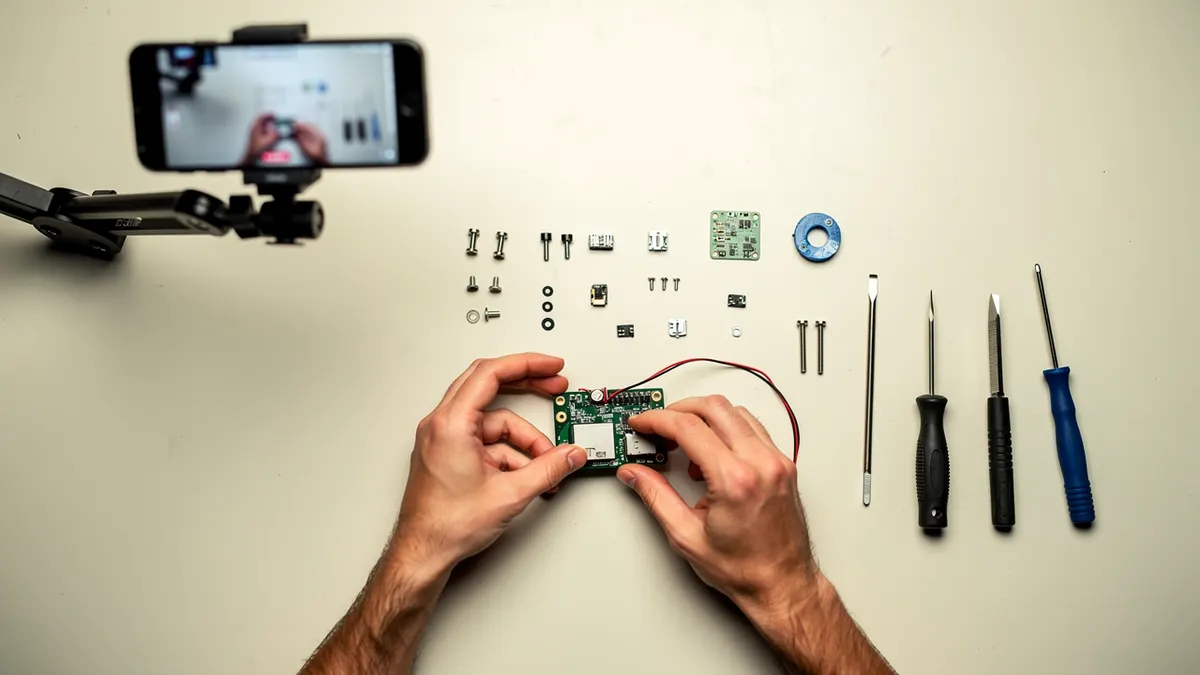
The framing of the hands. Filming over the shoulder feels natural but hides the gesture; a shot perpendicular to the table, camera resting, shows exactly what the viewer has to reproduce.
What to prepare before switching the camera on
The product unwrapped, surfaces clean, everything within reach. A take ruined by a missing item costs more time than a dry run, and it shows on screen.
What gets it rejected
Uneven sound between steps, a blurred shot of the hands, a step filmed out of frame, and the absence of a version without text.
Those four faults have nothing to do with talent: they are corrected at the moment of the shoot, by checking each shot before moving to the next.
Sources
- Agencia Tributaria, Spanish tax authority
- Spanish Social Security, self-employed registration (RETA)
Checked on 4 September 2026. Thresholds and rates change: where this guide and the official source disagree, the official source is right.