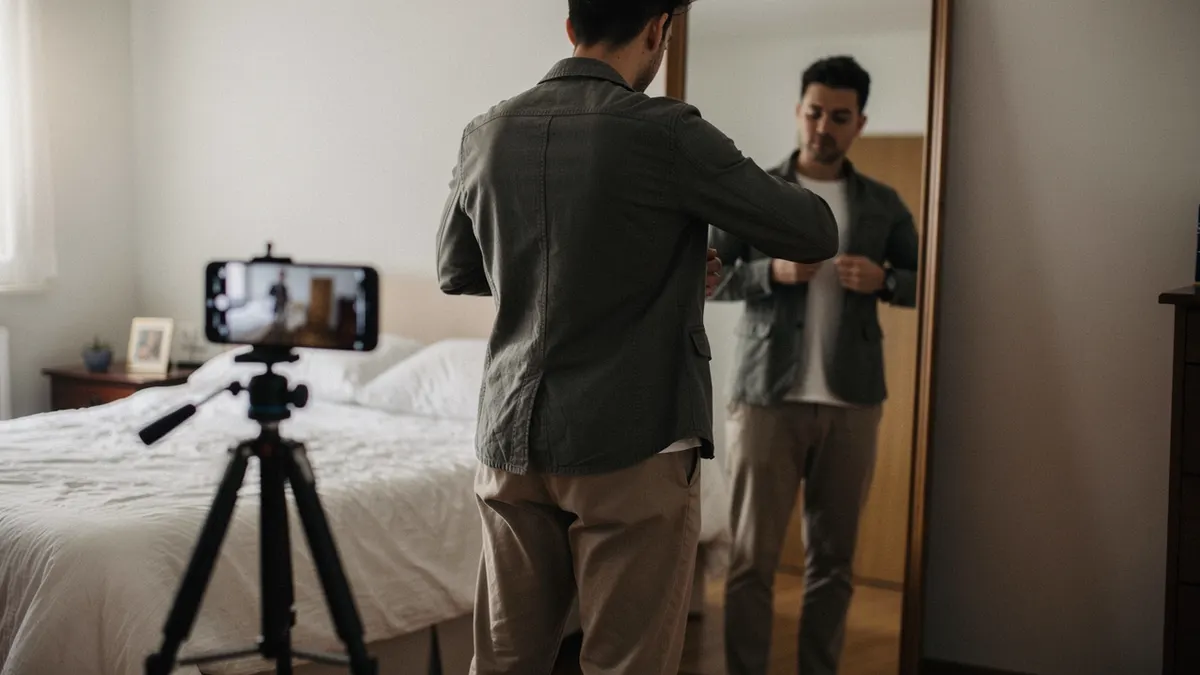

Hiring somebody to film in-house looks cheaper per video. What that calculation forgets.
What cost per video forgets
Five costs missing from the calculation.
The real time of a video, preparation and editing included, taking half a day of somebody paid full time.
The cost of the trials: the first weeks produce little usable material.
The opportunity cost, that is, what that person is not doing during that time.
Equipment, software and a shooting space, which become necessary as soon as the rhythm rises.
And the cost of wear, dealt with above, which appears on no budget line.
One person, one face
Four structural limits.
One face cannot represent several audiences, yet a campaign often needs three.
One shooting location produces videos that all look alike, which speeds up fatigue.
One voice and one accent, in a vast country where linguistic habits vary.
And an absence, a leave or a departure stops the whole production at once.
What in-house really does well
Five areas where it is superior.
Service content: opening hours, shipping, the answer to a frequent question.
The workshop and the making, which nobody else can film.
Urgency: a stock shortage, information to correct the same day.
Low-stakes format tests, before committing a budget.
And knowledge of customer questions, the raw material of every script.
The volume threshold
Three markers for deciding.
Below four videos a month, in-house costs more than it brings, because the person is not busy.
Between four and about ten, the answer depends on what that person does the rest of the time.
Above that, the constraint is no longer cost but variety: several faces are needed, which in-house does not supply.
One note: the threshold is not measured in videos produced, but in videos usable and published. Many in-house teams produce a lot and publish little.
What each option brings to volume
| Need | An in-house team | External creators |
|---|---|---|
| Ten videos a month | Underused | Well sized |
| Fifty videos a month | Cost-effective | Heavy coordination |
| A one-off peak | Impossible to absorb | Absorbed in a week |
What costs more than the shoot
Coordination. Beyond ten simultaneous creators, you need someone whose job is tracking briefs, shipments and approvals, otherwise quality drops.
What is tested before deciding
Two months of external production, then an honest calculation: cost per delivered video, internal time consumed, and share of videos actually released. The third figure is the one people forget.
The version that generally works
A split applicable from the first month.
In-house produces two to four pieces a month: service, making, answers to questions.
Outside produces the variants intended for advertising, with several different faces.
In-house writes the briefs, because it knows the customers.
Outside delivers the raw files as well as the edits, to produce variants with no new shoot.
And the selection of angles, the approval of what may be said and the archiving of rights stay in-house, whatever happens.
One last marker: the question is not who films most cheaply, it is how many different faces your advertising will consume this year. If the answer is one, in-house is enough. If it is three or more, no salaried post will replace a pool.