Taste cannot be filmed. A food video therefore never sells a flavour: it sells a moment, a texture and a sound.
Sound is the only substitute for taste
That is the discovery every food brand makes on looking at its own results.
The crunch, the sizzle, the spoon breaking a crust, the liquid pouring, the steam escaping: those are the only signals producing a physical reaction in the viewer.
So record the sound as close as possible, with no music over it, and leave at least two seconds of sound alone, with no voice.
A food video with a generic soundtrack on top loses its only argument.
Texture replaces description
That is the second substitute, and it is visual.
The cheese stretching, the sauce coating, the crumb tearing, the ice cream melting slightly at the edge, the bread opening.
Film those gestures very close and slowly, with side light rather than frontal: that is what gives relief to the matter.
And film at the exact moment of serving. A dish filmed five minutes too late has lost what made it desirable.
The moment counts as much as the product
That is what distinguishes a local video from an imported one.
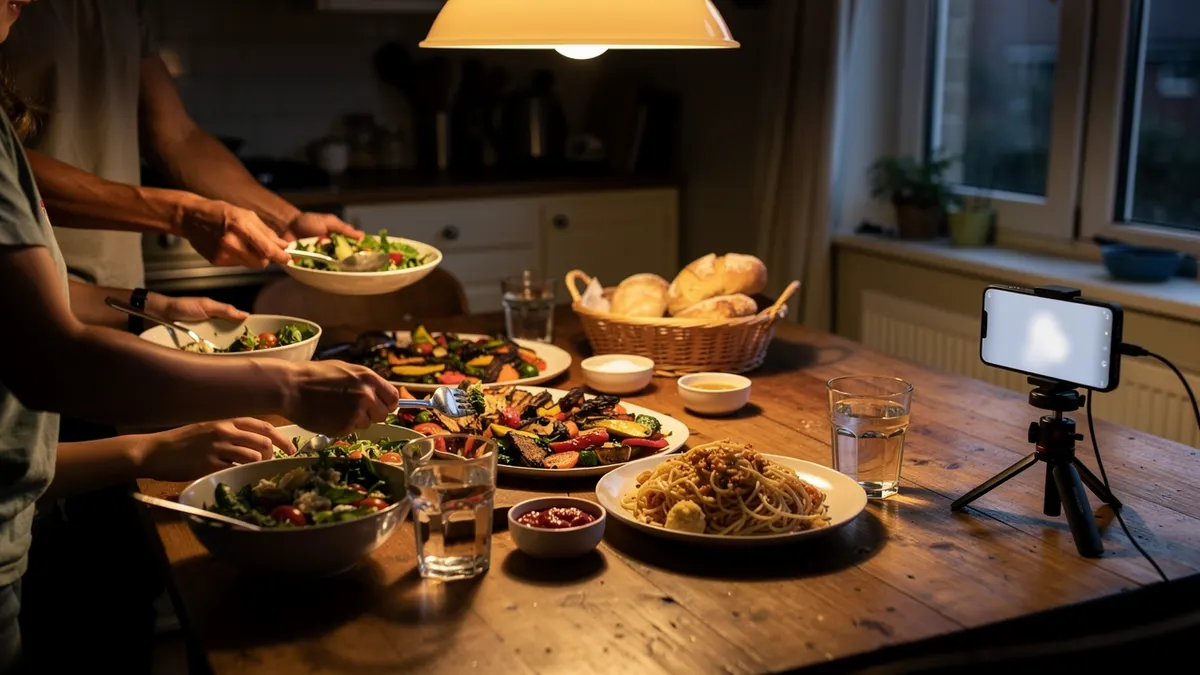
Here, food is rarely solitary: it accompanies a gathering, an outing, a sharing, a Sunday with family, a celebration.
So show several hands in frame, several plates, the shared table, the dish in the centre. A product filmed alone on an immaculate worktop looks like a foreign catalogue.
Add the real consumption context: the heat, the street, the journey, work, the time of day.
Sharing is the majority context
That is the practical consequence, and it changes the format.
A product that is shared must be filmed in quantity: the bag open in the middle of the table, the portion divided, the second round.
It also changes the price argument: the cost per person weighs more than the displayed price, and it is said out loud.
The creator to choose
Two criteria, in that order.
The person must cook or eat like the audience: same available ingredients, same kitchen, same budget, same hours.
And they must accept filming without tidying the house. An over-tidy kitchen destroys the credibility of food content faster than in any other category.
What is filmed, and in what order
| Shot | What it shows | Shooting window |
|---|---|---|
| The sealed product | The format and the label | Unlimited |
| The preparation | The gesture and the texture | A few minutes |
| The first bite | The real reaction | One take only |
What is prepared before opening the pack
The background, the light, clean cutlery, a second unit of the product. Steam, melting and colour cannot be replayed once gone.
What is read on screen rather than spoken
The ingredient list, the allergens and the nutritional values. Filming the label avoids rephrasing, and a loose rephrasing becomes a claim, to be confirmed with a lawyer.
What is not said
Three families of claims demand particular vigilance.
Nutritional and health claims, which follow precise rules and authorised wordings.
Comparisons with other products, which bind the brand.
And everything touching children, school and young audiences, whose framework is stricter.
The working rule is simple: the brand supplies the authorised wordings in writing, the creator repeats them word for word, and everything else is cut in the edit.