Factories are setting up, recruiting and looking for suppliers. They need video every month, and almost nobody offers it to them locally.
The client is not the marketing department
That is what throws creators coming from brand content.
In a factory, video is commissioned by human resources, by internal communication, by quality assurance or by business development. Rarely by a marketing department, which sometimes does not exist on site.
These people do not talk about trends: they talk about vacancies, turnover rates, client audits, safety and deadlines.
So adapt the vocabulary of your offer. The word that opens the door is not "content", it is "recruitment", "training" or "audit".
The industrial recruitment video
It is the most regular need, because it comes back with every hiring wave.
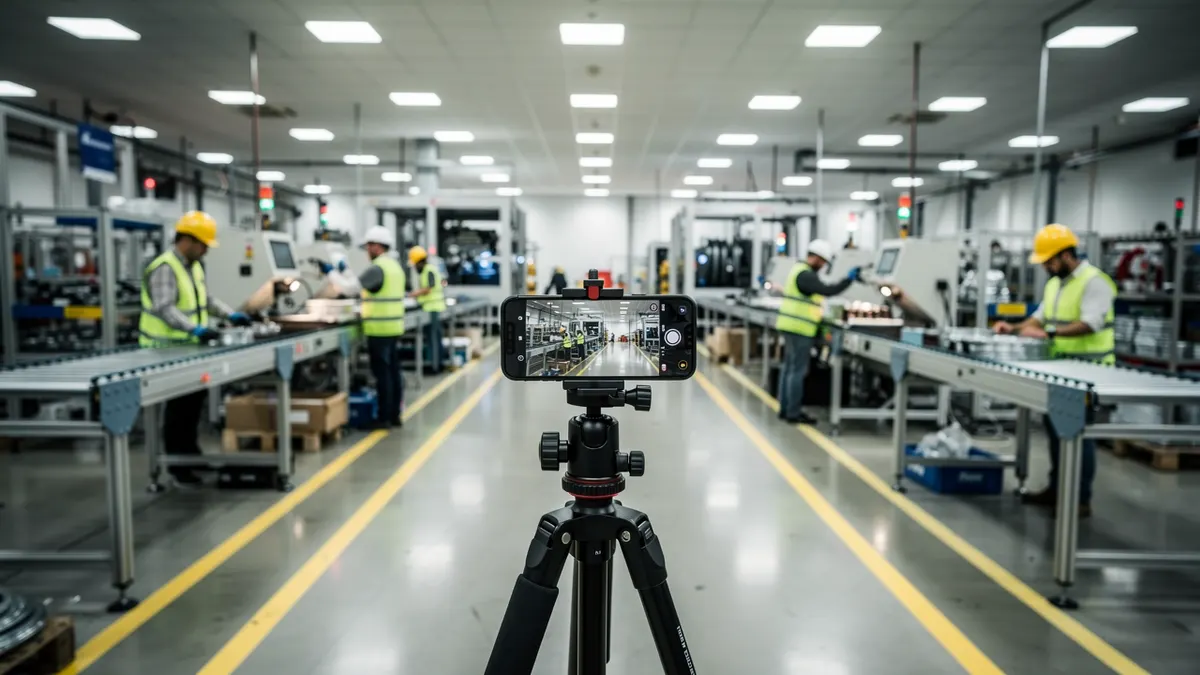
Three formats cover the essentials. The tour of the job, filmed on the line, showing the real movement rather than the atmosphere. The testimonial of an operator explaining their internal path. And the typical day, answering the questions of transport, hours and canteen.
These videos are not shot like an advertisement: protective equipment visible, authorised zones, machines stopped when the rule requires it.
Ask for the list of constraints before scouting. The applicable rules depend on the site and are checked with the safety manager, never improvised on the day of the shoot.
Communication towards buyers
That is the second budget, and it is better funded.
A foreign buyer considering a Mexican supplier wants to see three things: real capacity, traceability and consistency.
That gives very concrete videos: the line in operation, quality control, the warehouse, the laboratory, dispatch preparation, the tracking of a batch.
Add the certification video: what the plant has obtained, what it implies in the process, and how it is verified. It is what the buyer will ask for anyway.
The bilingual requirement is constant
It is not an extra, it is the norm on this market.
The Spanish version serves recruitment and internal use. The English version serves clients, audits and head office.
Two practical rules. Record the voice in both languages at the shoot, not in the edit: bringing the person back costs a day. And keep on-screen text in a separate file, so it can be replaced without re-exporting the edit.
What proximity really changes
| Point | Concrete effect | What it avoids |
|---|---|---|
| The time zone | An exchange the same day | An approval losing 24 hours |
| Shipping time | A product received in a few days | A shoot pushed back a month |
| A shared language | A brief understood first time | Three rounds of clarification |
What is checked before moving a shoot abroad
The product's real availability on site, the exact language expected on screen, and the mandatory notices of the country of broadcast, not of the country of filming.
What cannot be relocated
An identifiable place, a recognised local accent, or a product sold only in the target country. Those three are filmed where they exist.
Who to approach
Four doors, in order of how easily they open.
Recently established plants, which do not yet have a usual supplier and are recruiting in volume.
Industrial parks, which communicate to attract tenants and have their own budget.
Tier-two suppliers, smaller, who must prove their capacity to enter a chain.
And the chambers and sector associations, which do not commission much but introduce you to everybody. One free talk there is often worth three months of prospecting.
Sources
Checked on 4 September 2026. Thresholds and rates change: where this guide and the official source disagree, the official source is right.