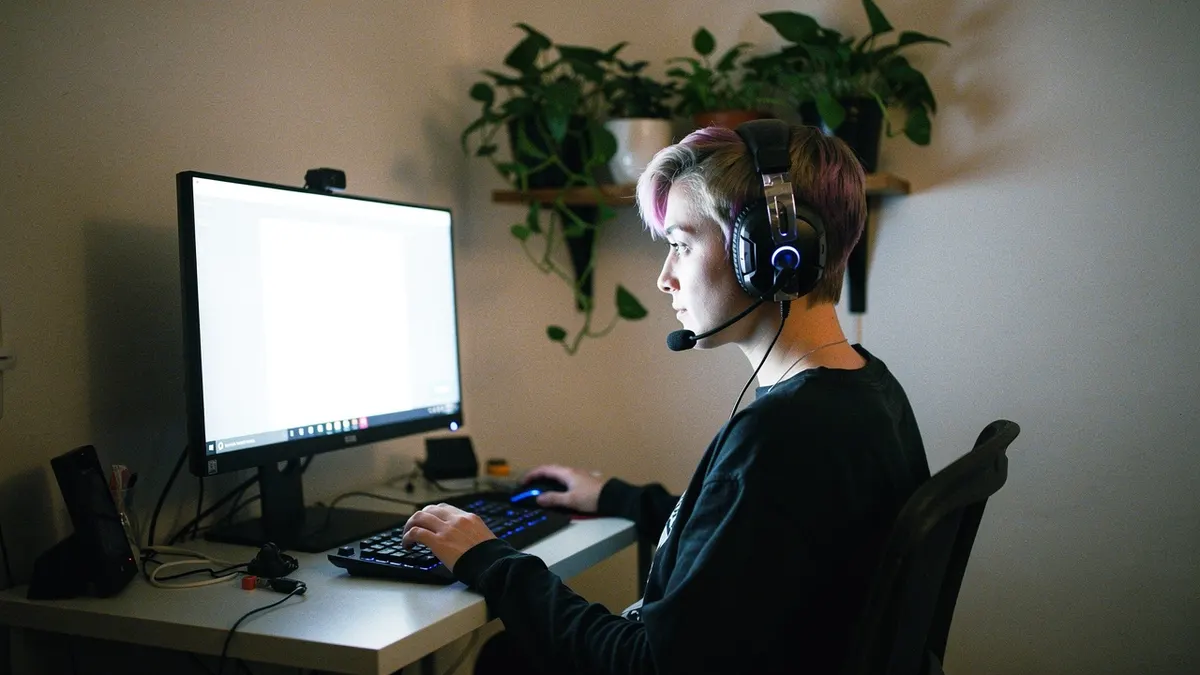
In this category videos almost always show new equipment, in a dedicated room, lit in red and blue, with a player alone.
French reality rarely looks like that. People play in a flat, often in a bedroom, with neighbours behind a thin wall, a flatshare, or a family on the other side of the partition.
That constraint decides two things almost no video addresses.
Noise is a purchase criterion
A mechanical keyboard, a fan, a chair that creaks, a microphone that picks up everything: these are the questions the buyer genuinely asks before ordering.
Film them. The sound of the keyboard recorded with no music over it, during the day and then at two in the morning. The noise of the machine under load. What the microphone picks up when someone speaks in the next room.
Those are the only shots that answer the question asked, and they are the ones brands cut because they are not pretty.
What the French audience punishes
Advertising vocabulary stuck onto hardware. A community used to technical comparison spots a brand-written sentence immediately.
Performance figures announced without conditions: without stating the configuration, the resolution and the settings, a number means nothing, and saying it that way discredits everything else.
And the player who does not play. A creator handling a product without understanding its use is spotted in three seconds.
What to show, in order
The real setup, including the trailing cable and the desk that is too small.
The product in play, during an actual session, with the game sound and the player's voice.
The comparison with what the person used before, which is the only useful reference for someone about to replace an object.
And the end of the session: what they keep, what bothers them, what they would buy again.
Who to film
Players who practise the genre matching the product. Hardware designed for fast aiming filmed on a management game proves nothing.
Average setups rather than exceptional machines. Most of the audience plays on what they have, and a demonstration on high-end hardware does not transpose.
And people able to speak plainly. Jargon excludes part of an audience that nevertheless buys.
The capture constraint
A gaming video requires a clean capture: the screen, the voice, sometimes the webcam, synchronised and legible on a phone.
That is a skill in itself, different from that of a creator filming everyday products. Ask for a capture sample before hiring, and specify in the brief what you want on screen: the game full frame or the player inset.
Also plan for file size and how the files will be transferred. It is a practical point that costs several days when it has not been anticipated.
What goes wrong when filming a screen
Seven mistakes that ruin a take.
Flicker because the frame rate does not match.
A reflection of the lamp on the display.
A chat window showing real people's names.
A display revealing the progress of an account.
Audio containing protected music.
A scene that does not match the age rating.
And a frame showing a brand that is not paying.
What is set before capture
| Setting | Useful value | What it prevents |
|---|---|---|
| Capture frame rate | Matched to the game | Flicker |
| Chat and notifications | Closed | A stranger's handle on screen |
| In-game music | Muted or cleared | A block at release |
What is filmed off screen
Hands on the controller, the headset resting, the seat being adjusted, the reaction on the face.
What is checked before sending
No account data visible, the stated age rating, the game build and the advertising disclosure.
The calendar
The end of the year concentrates most purchases, and the videos must be ready before, not during.
The September return is the second peak, with setup renewal and the resumption of regular sessions.
The rest of the year serves what does not date: endurance tests, comparisons, answers to the questions that keep coming back in the comments.
Sources
Checked on 4 September 2026. Thresholds and rates change: where this guide and the official source disagree, the official source is right.