Winter tyres, block heaters and a buyer who keeps their vehicle for ten years. Here is what the video must prove and what it must not promise.
Winter is the differentiator
That is what separates a video shot there from an imported one.
Five proofs that cannot be improvised.
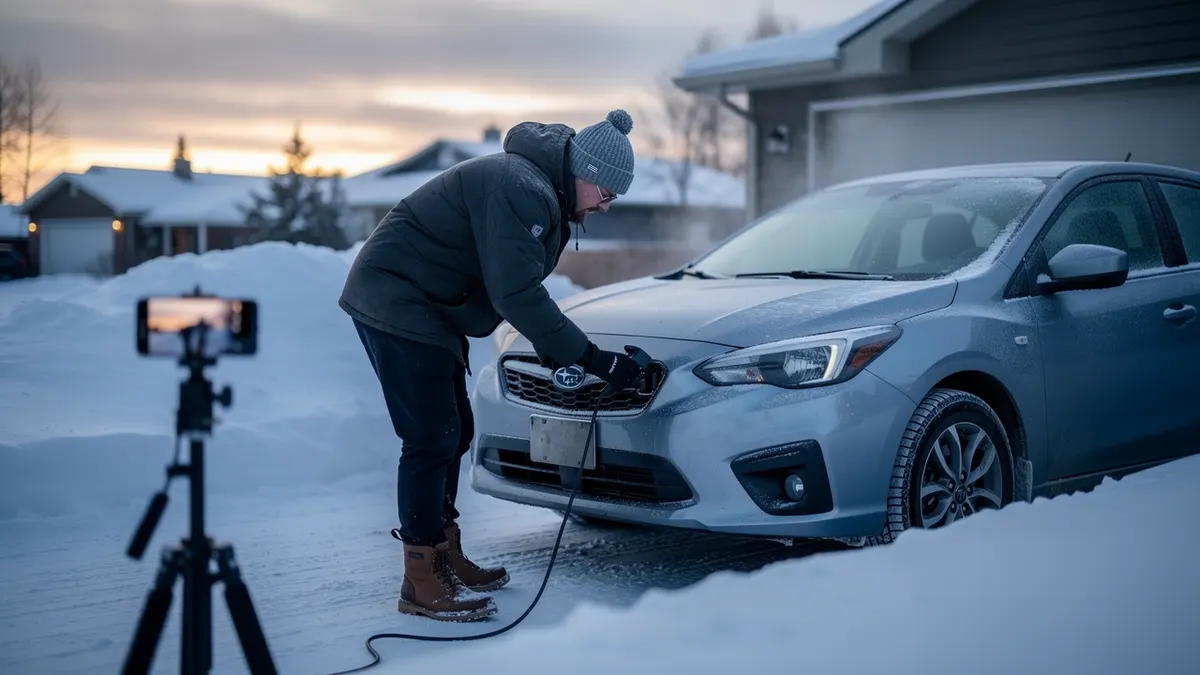
The start after a night outside, filmed with no cut, with the temperature displayed.
The real de-icing: how long before the windscreen is clear.
The time a heated seat takes to become useful.
The behaviour on a snow-covered road, filmed carefully and with no dangerous manoeuvre.
And the range or consumption that changes with the cold, without drawing from it a figure presented as official.
One precaution: any consumption, range or emissions figure must match exactly the official data of the model, and is checked before the shoot.
What to film that nobody films
Four sequences, all useful twelve months a year.
The tyre change: what it costs, how long it takes, where the other set is stored.
The boot really loaded, with the winter equipment inside.
The controls used with mitts on, to show what can be handled without taking them off.
And the salt cleaning, which decides the vehicle's condition at resale.
The dealership is the client nobody serves
That is the entry point for creators in this category.
A dealership sells used vehicles that change every week, each needing a filmed tour, and almost nobody offers them that work.
Three arguments that work with them. One filmed tour per vehicle, shot in twenty minutes. An identical format from one vehicle to the next, therefore recognisable. And same-day delivery, because stock moves fast.
One production point: film with the person who greets visitors. The audience comes to see a vehicle, but it comes to meet somebody.
Used vehicles and trade-ins are a category of their own
Three pieces of content the audience looks for and the market does not produce.
The real condition of a seven-year-old vehicle, flaws included, filmed in natural light.
The course of a trade-in: what is inspected, what lowers the value, what does not count.
And the account of an owner after a hundred and fifty thousand kilometres, with the real servicing and its cost.
Three prohibitions, valid across the category. No readable plate or personal document on screen. No manoeuvre breaking the road rules. And no named comparison without a documented measurement and prior approval, checked with a lawyer.
What is filmed on a vehicle
| Shot | What it proves | Constraint |
|---|---|---|
| The exterior in motion | The lines and the stability | Two people, safety first |
| The cabin at a standstill | Materials and space | Difficult light |
| Winter behaviour | Starting up, defrosting | One season a year only |
What is prepared before filming
A clean vehicle, a masked plate, a private or authorised location, and a driver who is not the person filming. No shot justifies taking a risk.
What is never claimed without a document
A consumption figure, a cold-weather range, a power output or a delivery time. Those come from the official specification, to be confirmed with the manufacturer.
The buying calendar
Three moments structure the year.
The autumn, before the first snow, when tyres, accessories and sometimes the vehicle itself are decided.
The spring, when servicing, cleaning and purchase plans start again together.
And the end of the year, for special-series offers and registrations.
Two production rules. Seasonal content must be online three weeks before each peak. And winter videos are shot in January, never reconstructed in June: the cold shows, and fake breath is heard in the silence of the video.
One last local obligation: on that market the French version is not a subtitling, and commercial display as well as mandatory statements follow precise language rules depending on the province, to be checked with a lawyer before publication.
Sources
Checked on 4 September 2026. Thresholds and rates change: where this guide and the official source disagree, the official source is right.