It is the oldest format in advertising and the easiest to make implausible. A single badly placed sentence turns a testimonial into a recited text.
Precise beats enthusiastic
That is the rule that decides everything.
"It's great, I recommend it" brings nothing: no information, no possible verification, no connection with the situation of the person watching.
"I have used it for four months, I wash it once a week, the bottom seam has shifted and the rest has not changed" brings everything.
So ask for dated, numbered facts: since when, how often, in what conditions, compared with what.
Include something imperfect
It is counter-intuitive, and it is what makes the rest credible.
A testimonial with no reservation reads as an advert, because no object is perfect and everybody knows it.
So have a real, minor limitation stated: the high price, the colour that shows dirt, the learning time, the size to go up.
It costs the brand nothing and it buys trust for the whole rest of the video. It is the part the client will want to cut, and the one to defend.
Do not write the words
That is the difference between a testimonial and a reading.
Give constraints rather than a script: the points to cover, the length, what must not be said, the number of takes.
Somebody reciting is recognised immediately, by the rhythm and the eyes. Somebody answering a question speaks normally.
So ask questions and film the answers, cutting the question in the edit if needed.
Film at their place
The set carries half the credibility.
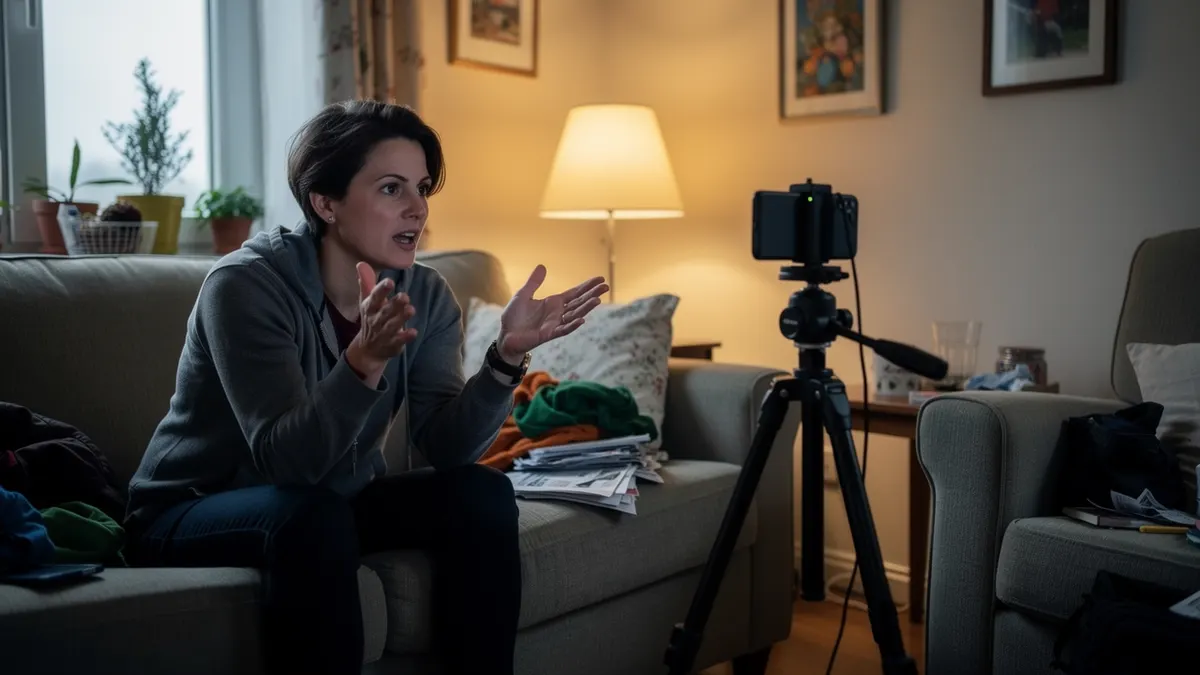
A neutral background, studio lighting, centred framing: all that signals a production. A kitchen, a corridor, a car, a workshop signal a person.
So accept the mess, the background noise, the imperfect light. The only non-negotiable technical point is the sound: the voice must be clear, everything else can be approximate.
What the format cannot do
That is the legal limit, and it is strict.
A testimonial proves nothing. It cannot support a claim the brand has no right to make itself, particularly on health, efficacy, results and safety.
Three precautions. Never have somebody say what the brand could not write. Identify the commercial nature, including when the person speaks sincerely. And keep the person's written agreement, with the duration and the media.
The applicable rules depend on the product and the medium, and are checked with a lawyer before publication.
What makes a testimonial credible
| Element | What works | What rings false |
|---|---|---|
| The opening | The moment of doubt | A self-introduction |
| The middle | A concrete, checkable detail | A list of benefits |
| The ending | An honest limit | A superlative |
What is prepared without writing a script
Three questions asked off camera, and answers given once only. A memorised testimonial is heard in the rhythm and loses everything that made it useful.
What is kept in the edit
The hesitation before the difficult answer and the spontaneous rephrasing. Those are the two marks of unscripted speech, and viewers spot them without naming them.
The Canadian point
Two language versions, two different people.
A dubbed or subtitled testimonial loses exactly what makes it strong: the way of speaking. The audience immediately hears a voice that is not the person's.
So film two separate testimonials rather than one translated, and let each recount their experience in their own words.