The start of the school year does not have the same date in every region and the buying window lasts three weeks. How to shoot in July for September.
A short and regional season
Three facts structuring the campaign.
The start dates differ by region, which spreads the period over several weeks instead of a single peak.
The useful buying window stays short, about three weeks per region.
And the purchase is triggered by receiving the list, not by a calendar date.
One publication consequence: a national campaign is scheduled in regional waves, with the same content and different dates. Publishing everywhere at once wastes half the budget.
What really sells
Five families, by volume.
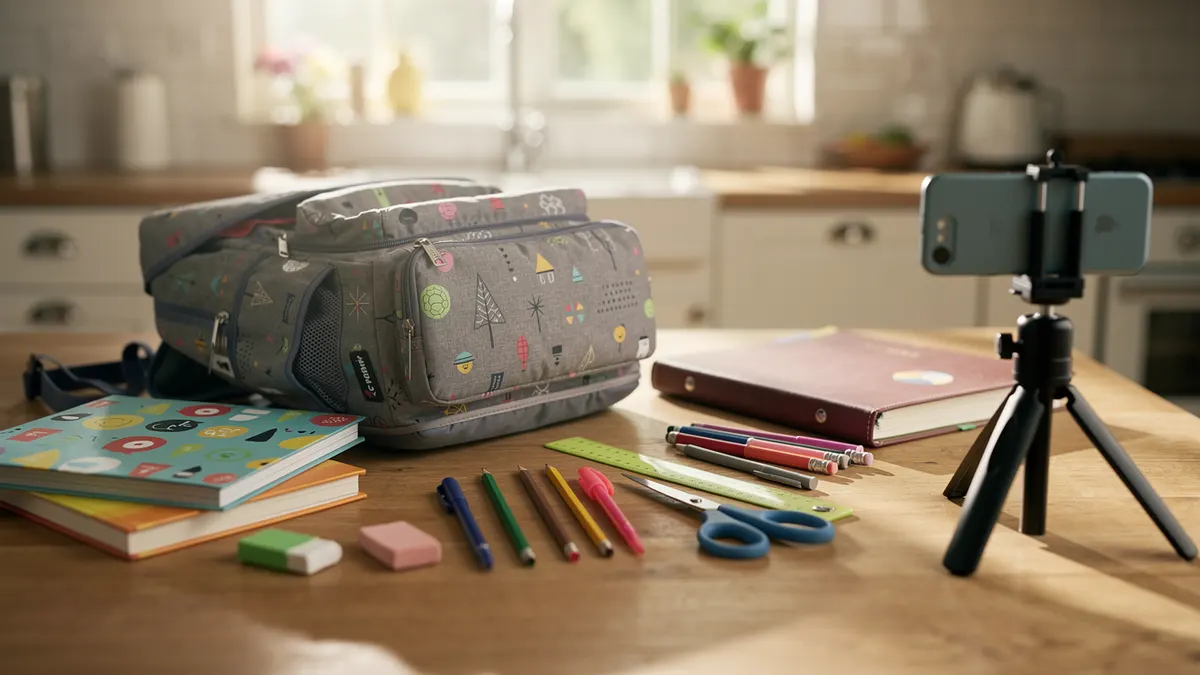
Basic supplies, bought quickly and without hesitation.
Bags and containers, the only item where style counts as much as strength.
Clothes and shoes, with the constraint of sizes.
Equipment for working at home: lamp, desk, storage.
And electronics and software, bought later, often in October.
The second wave
Three reasons to keep budget for October.
What breaks in the first weeks is replaced immediately.
What is missing from the list appears only after the first days of class.
And extracurricular activities start with their own equipment needs.
That second wave has little competition, so it is cheaper to reach, and almost nobody prepares it.
The parent buys, the child refuses
Four practices that raise the conversion rate.
Have the object held by somebody of the age concerned, which gives scale and credibility.
Show the bag full, not empty, with the real weight.
Say the price, or at least the range, because silence about price makes people close the video.
And show the object after a month of use where possible, an unbeatable argument for the adult.
One precaution: filming a child requires the written authorisation of the legal guardians, and the rules applying to advertising aimed at minors are strict. They are checked with a lawyer before the shoot.
What to avoid filming
Five things that make the campaign fail.
The name, uniform or emblem of an identifiable school.
The faces of other children in the playground or the street.
The comparison that devalues what families already own.
Pressure about newness, badly received in a period of constrained spending.
And the message suggesting a child will be excluded without the product, an angle to be set aside on principle.
Three moments, three different videos
| Moment | What interests the buyer | Format |
|---|---|---|
| The list to prepare | What is really needed | A comparison video |
| The product test | Sturdiness and comfort | A demonstration |
| The first week | What holds up in use | A dated follow-up |
What is settled before filming a child
Written consent from both parents, a shoot showing no identifiable school or uniform, and a short duration. When in doubt, film the hands and the object.
What is not announced
A school result, an unverified safety standard, or compliance with an official curriculum. Those claims are confirmed with the manufacturer and the competent authority.
Producing in June
Five steps, with the real dates.
May: writing and approval, legal approval included.
June: shooting, before the holidays and while the creators are available.
Early July: editing and regional versions.
Mid-August: adding the prices and the disclosures.
And late August: publication, in waves, according to the start dates.
One last marker: the video that converts in this category is neither the prettiest nor the most moving, it is the one ending a fifteen-minute family negotiation by showing, in the same shot, what pleases the child and what reassures whoever pays.