The toy year there ends on 6 January, not on 25 December, and filming children brings its own rules. Both change the plan.
The calendar that decides the year
Four periods, and they are not alike.
September and October: retailers list, catalogues close, and content shot now will serve the whole season.
November: demand builds, lists form, and the most watched videos are those helping to choose between two similar products.
December: the first wave of purchases, with maximum competition and a high distribution cost.
And the first week of January: the second wave, less crowded, often more profitable, and almost abandoned by foreign brands.
Filming children is nothing like the rest
Consent comes from those with parental authority, in writing, and it is precise
It states the duration, the media, the territory, and what happens on withdrawal. It is signed before the shoot, never on the day.
A minor must not be the one who sells
The child plays, handles, reacts. They do not recommend, do not quote a price, and never address other children directly to push them to ask for a purchase.
Personal data stays out of frame
No surname, no school, no uniform, no number plate, no view that could place a home.
The creator decides what the child does
The brand writes what it wants shown, never what the child must do or say. If the child tires, the take stops, and that appears in the brief.
Advertising aimed at children has its own rules
The mentions, formats and permitted practices depend on the medium and the audience, and are checked with the competent authorities before publication.
The briefs that work
Four precise requests, and they are enough.
The real assembly of the toy, with a clock displayed, including the number of batteries and the tool needed.
Ten minutes of free play, with no instruction, from which twenty seconds will be kept.
The state of the toy after three weeks of use, filmed later.
And an adult voice, carrying the useful information while the child's hands show.
What is required when toys are on camera
Six rules that apply beforehand.
The age rating must match the use shown.
Small parts must not sit within a toddler's reach.
Assembly is either shown in full or left out.
Batteries and their compartment must appear closed.
No child appears without parental consent.
And no promise about learning outcomes.
What the rules impose when a child appears
| Point | What is needed | Otherwise |
|---|---|---|
| Permission | Written consent from both parents | No release |
| Duration | A short shoot, outside school hours | A shoot that unravels |
| Wording | No direct appeal to the child | A rejected ad |
What is filmed without a face
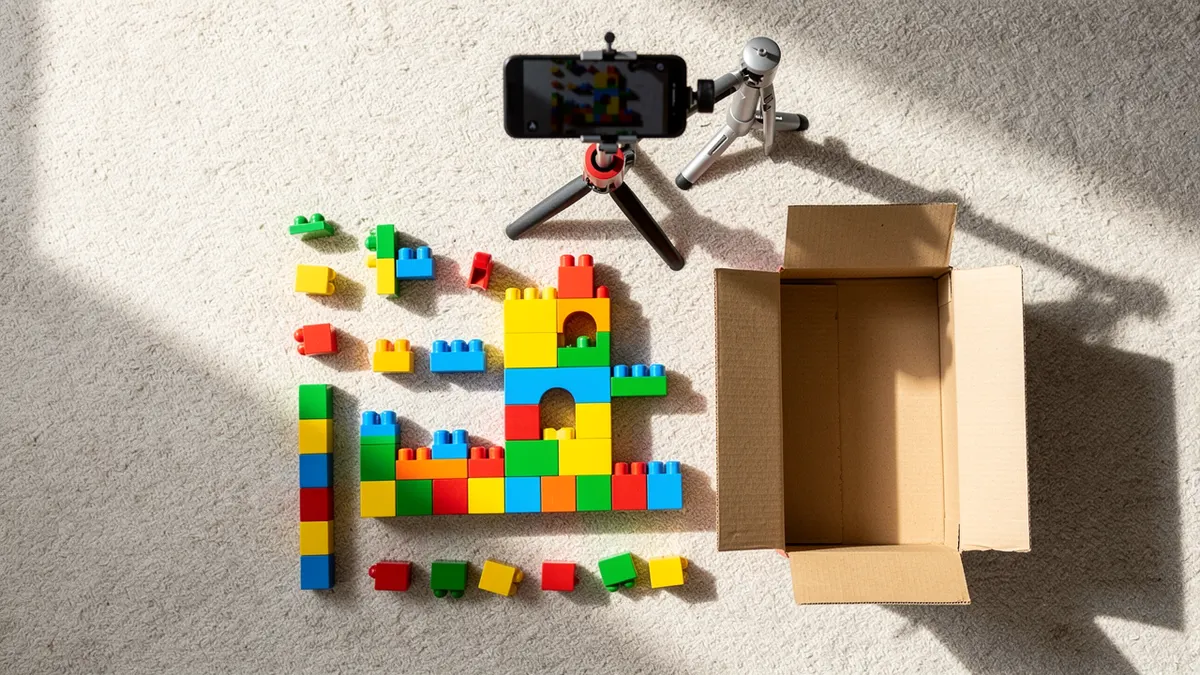
The hands opening the box, the game seen from above, the tidying up at the end. The toy is the subject, and those shots avoid every permission tied to a minor's image.
What is read on screen rather than spoken
The recommended age, the number of pieces, whether batteries are needed and the safety warnings. Filming the box avoids rephrasing, to be confirmed with a lawyer.
Practical notes for the brand
Five decisions that change the result.
Shoot in summer to publish in November, with no seasonal setting at all.
Systematically plan two edits: one with the child on screen, one without, usable immediately if an authorisation is withdrawn.
Ask for the original sound: the toy's noise is part of the buying decision.
Keep long rights, eighteen months minimum, to cover two seasons.
And plan an after-the-holiday variant, shot the same day, showing the toy in ordinary use. That is the content working all through January, when everybody has stopped publishing and purchases are still going on.