Three compulsory sentences, three forbidden ones, and the two lines that stop a bilingual campaign costing double.
Three sentences that must be said
They fit in three lines, and they avoid nearly all the back and forth.
What the video must prove, in one sentence starting with what the person must believe at the end.
The imposed mentions, word for word, in a separate box.
And the delivery date, calculated from receipt of the product and not from sending the brief.
Three sentences that must not be said
They are listed explicitly, because a creator does not guess what is forbidden.
Any promise of a result or performance not supported by a documented test.
Any comparison naming a competitor.
And any rewording of a compulsory mention, even to make it flow better.
One rule for all three: the list of forbidden words must be supplied before the shoot, never discovered in the edit.
The two specifically Canadian lines
They stop a bilingual campaign costing twice its price.
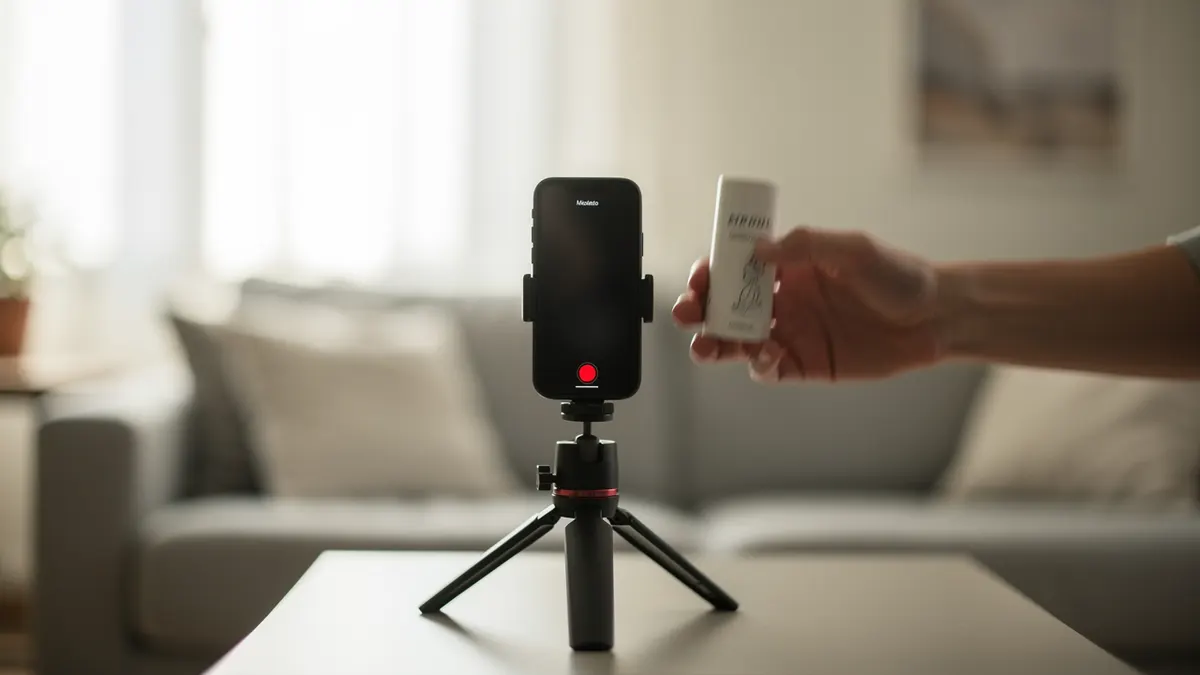
The first: the shooting language, decided in the brief. A version in the second language is not a translation, it is a second shoot, with somebody for whom it is the everyday language.
The second: no text burnt into the image. Any band engraved in the image forces you to produce two files and maintain them separately, whereas a clean file plus two subtitle tracks are swapped in five minutes.
One production remark: shoot both versions the same day, with the same product and the same light. Bringing a crew back three weeks later costs more than the second take, and the difference shows on screen.
Say what you are going to receive
Five deliverables, listed in the brief, with their format.
The number of videos and their length.
The number of different hooks.
The formats: vertical, square, horizontal.
The raw files, delivered or not.
And the photographs taken during the shoot, if you want them.
That list fits in five lines and removes every post-delivery discussion.
What a brief must fix
| Element | What it avoids | Length |
|---|---|---|
| The product and its reference | Filming the wrong model | One line |
| The forbidden sentences | A complete reshoot | Three lines |
| The expected languages | A missing version | One line |
| The formats and naming | An export to redo | Two lines |
What is specified in a bilingual market
The language of the script, that of the subtitles and that of the on-screen notices. Those three are not always the same, and the omission costs a full reshoot.
What is checked before the shoot
A photo of the set and the first line of the script, sent by the creator. Two minutes of checking avoid a day being redone.
Leave the how alone
Three things never to impose.
The shooting location: the creator knows their light and their constraints.
The exact words, outside compulsory mentions: a text written by the brand and read by somebody else is heard in three seconds.
And the shot-by-shot running order: ask what must be visible, not the order in which to film it.
One last habit, typical of campaigns that work there: add a sentence to the brief saying the creator may refuse an instruction they judge inaccurate or risky, and must flag it before shooting. That sentence costs one line, and it changes the relationship: the person filming becomes the first review of your compliance, instead of the one who executes without looking.