A hook is not an introductory sentence: it is the promise that decides whether the next forty seconds will be watched. It is worked on separately from the rest.
Five hooks on a single video body
It is the cheapest production structure.
The body of the video, the demonstration, the product, the conclusion, is shot only once. It is the first three seconds that change.
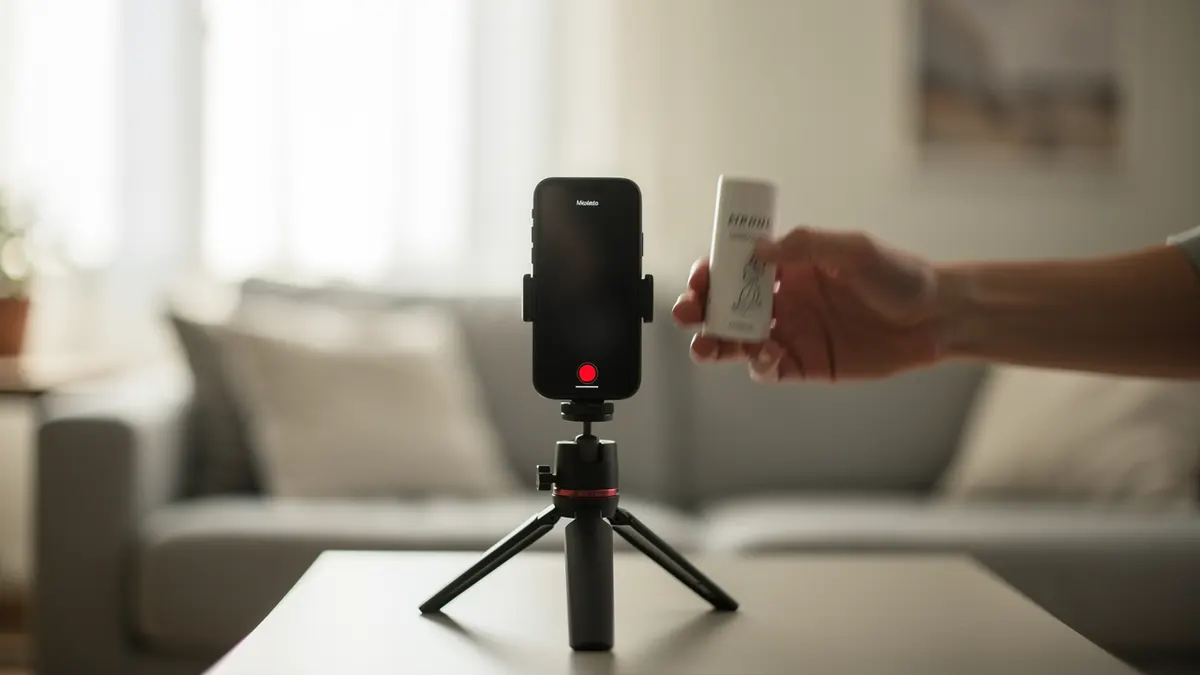
So film five different openings in a row, before putting the equipment away: a question, a figure, an objection, a result shown straight away, a sentence from the client.
You get five videos from one shoot, and comparison becomes possible: same body, same light, same person, only the entry varies.
Start in the middle
It is the most effective and the most counter-intuitive principle.
A video starting with "hi, today I'm going to show you" loses its audience before it has begun, because it announces instead of showing.
So come in mid-action: the hand already on the product, the sentence already started, the gesture already under way.
The context catches up in the second second. Attention does not catch up.
Show the thing, do not describe it
Two seconds of image are worth ten words.
If the product lifts a stain, show the stain. If it holds a door shut, show the door resisting. If it is small, put it next to a hand.
A visual hook has another advantage: it works without sound, so in the contexts where the video starts silent.
Then add short text on screen, three to five words, placed in the centre and not at the bottom, so it does not slip under the interface elements.
What only looks like it works
Four frequent traps, all measurable.
The artificial countdown, of the "wait for the end" kind: it inflates the retention rate and sells nothing.
The gratuitous shock, unrelated to the product: it attracts an audience that will never convert.
The trending music with no strong image: it merely moves attention onto the music.
And the deceitful hook, promising what the video does not show. It costs twice: in immediate drop-off, and in the brand's credibility. Claims remain subject to advertising rules, including in the first three seconds, and are checked before publication.
Four families of hooks and what they assume
| Family | What it says | What must follow |
|---|---|---|
| The problem | A situation recognised in one line | A solution shown |
| The reversal | What everyone wrongly believes | A proof |
| The number | A precise quantity | A verifiable source |
| The demonstration | A gesture started before the first word | A sharp shot |
What makes a hook testable
Three versions of the same opening, on the same edit. Without that constraint you are comparing two videos, not two hooks.
What kills a hook
A promise the rest does not keep. The viewer stays three seconds, realises they were baited, and the completion rate collapses.
The Canadian point
A hook is not translated, it is rewritten.
A sentence in English and its French translation have neither the same number of syllables nor the same rhythm: what fits in three seconds on one side takes four on the other, and the effect collapses.
So film the hook again in each language, with the words the person would spontaneously use, rather than subtitling.
And test the two versions separately: the same subject does not always have the same best opening from one market to the other.