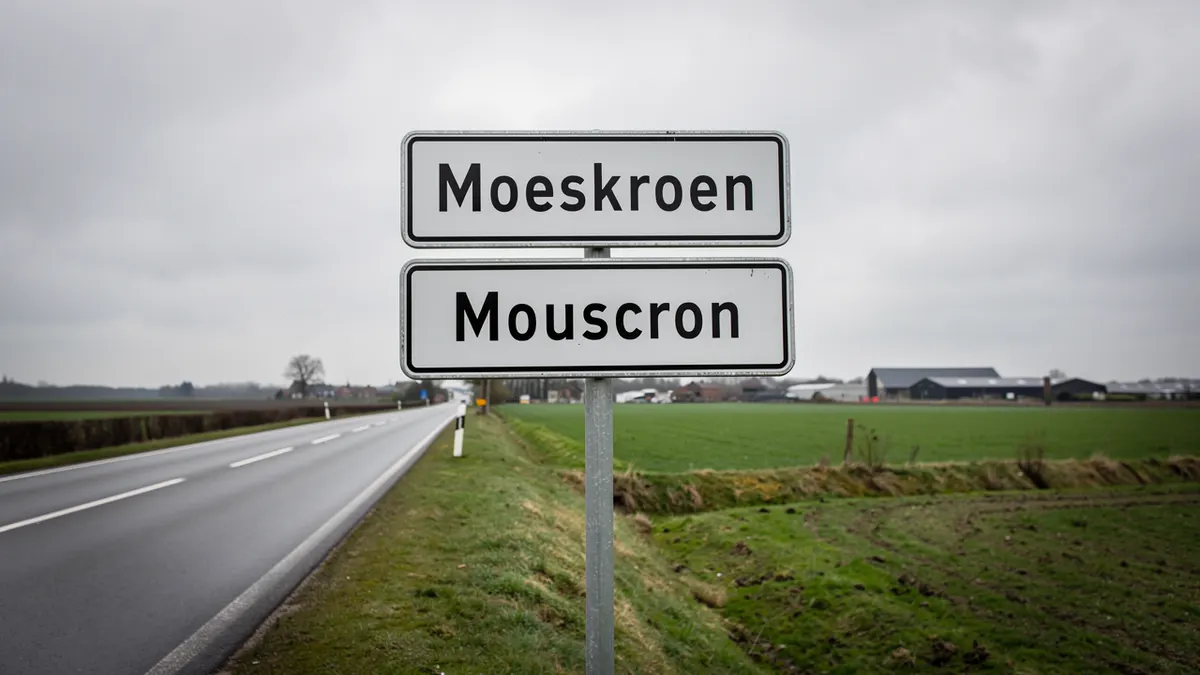
Every content brief has a line for the audience. Yours says Europe, and it is that line that will make the content fail.
Creator content needs somebody close, and yours does not exist
Why neutral European content reaches nobody
This format works because the viewer recognises somebody like themselves: a kitchen, an accent, a situation. An audience defined as Europe produces none of those recognitions: there is no average European kitchen, no European accent, no European daily life. Content aimed at everybody resembles nobody, and it is received as an official communication, which is what it is.
Brussels is where it is commissioned, not where it is filmed
The decision, the budget and the approval are here. The audience is elsewhere: in a village, a suburb, a medium-sized town in a given country. Filming near the commissioner is comfortable and systematically produces content that speaks to the commissioner rather than to the intended audience.
The risk is not underperformance
Brief what must not be said
For a brand, a bad video costs a budget. Here, a badly worded sentence costs something else: an out-of-context reuse, a controversy, a public correction. The brief therefore has to contain a list of formulations to avoid at least as long as the list of messages to convey, and that list is written with the person responsible for compliance, not afterwards.
Writing sentences that survive extraction
Six writing rules, all verifiable line by line.
One statement per sentence, never two joined by a but.
No figure without its source and its date in the same sentence.
No comparison between countries, even a flattering one.
No ironic wording, which reverses as soon as it is extracted.
No promise in the future tense, replaced by a description of what exists.
And no sentence whose meaning depends on the picture, since the text will travel alone.
Holding one message in languages you do not speak
Seven rules of multilingual production.
Writing the message in one sentence, before any translation.
Having it translated by somebody from the target country, never by a tool alone.
Having the translation proofread by a second person from the same country.
Filming with creators whose first language it is, without exception.
Forbidding improvisation on sensitive passages, while allowing it on the rest.
Having what was actually said translated back into your working language, for verification.
And keeping the approved version of each language, with its date.
Ask how you are allowed to buy, before framing anything
Six points to check with the competent department, before even writing the brief.
The procedure applicable to this kind of service, which is checked internally.
The thresholds that trigger a competitive process.
The real timescales of the procedure, often longer than the planned campaign.
The documents required from suppliers, which sometimes exclude independent creators.
The payment arrangements and their timescales, to be stated honestly to creators.
And the person authorised to approve wordings, whose name has to appear in the brief.
Choosing the markets, and how many
Six markers for avoiding the illusion of coverage.
Three markets handled properly are worth more than twelve handled superficially.
The choice is made on the objective, not on geographical representativeness.
Each market needs its own person, its own setting and its own language.
The same script can serve as a base, provided you accept that it will be reworded.
The cost per market falls from the third onwards, which argues for waves.
And a market with no local relay on the ground produces content nobody distributes.
What to put in the contract on the creator's side
Six clauses specific to this context.
The exact use, with the list of institutional channels concerned.
The duration, often longer than in the private sector, to be priced accordingly.
The right of withdrawal, and who triggers it.
The rule in case of out-of-context reuse, notably the support given to the creator.
A ban on modifying the edit in a way that would change the meaning.
And the disclosure of the institutional nature of the content, whose form is checked with the competent authority.
What changes with this type of commissioner
| Point | A classic brand | An institutional body |
|---|---|---|
| The message | Sell a product | Explain a mission |
| The tone | Direct and commercial | Sober and factual |
| The approval | Two people | Several departments, longer |
What is expected above all
Clarity. A successful institutional video explains a scheme in thirty seconds without simplifying it to the point of distortion, and that is a harder exercise than advertising.
What is never said without a source
A figure, a date of entry into force, an entitlement or a procedure. Each is proven by an official document, to be confirmed with the organisation and the competent authority before release.
How to measure, when there is no sale
Five indicators usable when there is nothing to buy.
Retention at fifteen seconds, the only reliable signal of real interest.
The full view rate, more telling than the number of views.
Questions asked in the comments, which reveal what was not understood.
Reuse by local relays, which indicates the content is usable.
And the number of information requests received afterwards, when such a channel exists.
One last marker: in Brussels, the audience line of the brief is the only decision that really counts. Replace Europe with a country, a town and a precise situation, and everything else becomes possible; keep Europe, and you will produce content nobody rejects and nobody watches.