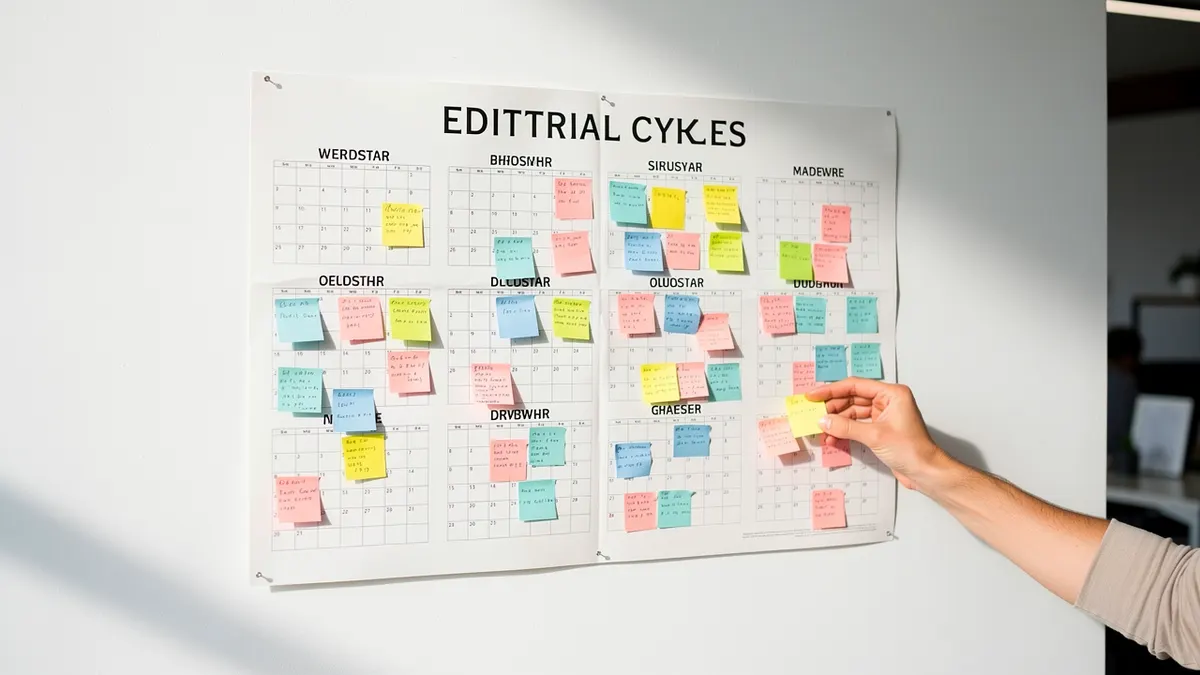
The commercial peaks that count, when to order the creatives, and how to plan a year of content in one afternoon.
The six-week rule
Four stages, with their real durations.
Selection and negotiation: a few days, more if the period is busy.
Shipping the product and its transport: the longest and least predictable variable.
The shoot and the delivery: generally a week after receipt.
And internal approval, corrections included: the item nobody counts, and often the longest.
One useful note: if your approval circuit involves more than two people, add a week. That is not pessimism, it is observation.
The commercial year
Five moments concentrate demand.
The start of the school year, which triggers purchases of equipment and clothes.
The end-of-year festivities, the first peak of the year, prepared from September.
The organised high-activity commercial periods, which require specific creatives and many variants.
The summer holidays, which move consumption outdoors and towards travel.
And Mother's Day, which remains one of the most regular peaks.
One seasonal note: summer and winter are reversed compared with the northern hemisphere. A campaign imported from a European market systematically arrives out of step if nobody checks.
What makes this calendar particular
Three factors specific to the market.
Prices move, which makes any video with a spoken amount unusable.
Financing offers change often, which means handling them as on-screen text rather than out loud.
And purchasing power varies strongly from one quarter to the next, which shifts the categories that sell.
One practical consequence: produce videos with no figures and no prices, and add those elements at the edit. The content's lifespan doubles.
How to plan a year in one afternoon
Five steps, in this order.
List the five commercial peaks of your sector, with their dates.
Count six weeks back to obtain five order dates.
Group the shoots: two sessions are often enough to cover four peaks, if the products are available.
Plan a batch of permanent content, described below.
And block the approval dates, with a person's name for each.
One organisational note: that document fits on one page. Its usefulness comes not from its complexity, but from the fact that it exists before November.
The content that does not expire
Four types of video usable all year.
The demonstration of use, with no price and no promotion.
The answer to recurring objections, taken from customer-service questions.
Care and durability of the product.
And recruitment content, which serves continuously in sectors that are hiring.
Those videos cost the same as the others and work ten times longer. They should make up half of any annual order.
What is planned over twelve weeks
| Rhythm | What you produce | Time per week |
|---|---|---|
| One shooting day a month | Six to eight videos | Six hours |
| One edit a week | Two versions | Three hours |
| One outreach round a week | Ten contacts | One hour |
What is set against local seasons
Summer concentrates outdoor use, the new term revives budgets, and the year end stacks holidays and payouts. A calendar that ignores those three facts does not hold.
What is kept in reserve
Two videos with no dated set, no weather and no price. They fill the week a client cancels, and prevent a week with nothing published.
What a production calendar actually contains
| The column | What it records | Why it helps |
|---|---|---|
| Product arrival date | The day the parcel lands | The shoot depends on it, not the reverse |
| Shooting date | The reserved slot | It protects against surprises |
| Promised delivery date | What the client expects | It commits, so it is kept |
What most often derails a schedule
The product's arrival. An order set with no margin between shipping and shooting slips as soon as a parcel takes three extra days, and it is the creator who looks late.
What is planned monthly rather than per order
Grouped shoots. Filming three products in the same session divides set-up time by three, and that saving only appears with a calendar kept in advance.
The most expensive mistake
Three forms of the same mistake.
Ordering in November for December, when every creator is booked and every lead time stretched.
Having a price or a number of instalments said out loud, which makes the video expire within weeks.
And producing only seasonal content, which forces you to start again every quarter.
One last marker, valid for any brand ordering regularly: always keep one batch in reserve. A campaign starting with three videos ready is steered; a campaign waiting for a delivery is endured.