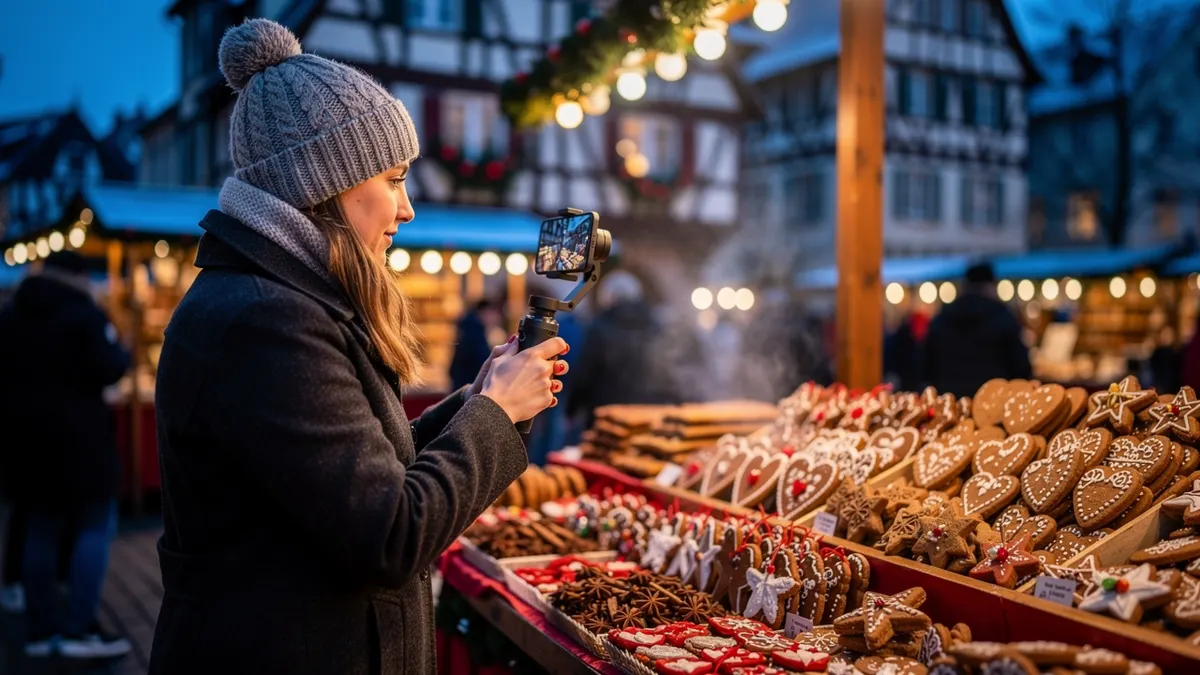
European institutions, a border ten minutes away and a Christmas market that carries the local economy for several weeks a year.
What the local economy buys
Six client categories.
Institutions and international organisations.
Service and consulting companies.
Shops and restaurants.
Accommodation and tourism operators.
Regional producers and brands.
And schools and training centres.
What institutions order
Six frequent formats.
Coverage of a conference or an event.
Recruitment content.
A programme presentation video.
Internal training content.
Communication toward the public.
And a subtitled version for accessibility.
What those clients require
Seven constant points.
A sober tone, with no promises.
Approval at several levels.
A purchase order issued before the start.
Systematic subtitling.
A version in several languages.
A compliant invoice with the right reference.
And strict respect of the announced deadline.
Making your profile readable on both sides
Six concrete actions.
Write the description in both languages.
Name the two zones covered.
State the travel time in minutes.
Show one example filmed on each side.
State the invoicing currency.
And specify who bears the transfer fees.
What cross-border clients ask first
Seven questions worth answering in your profile.
Which side of the border you are based on.
How long the drive actually takes.
Which languages you film in, and at what level.
Which currency you invoice in.
Who bears the transfer fees.
Whether you can deliver a second language version.
And how fast you answer a first message.
The end-of-year season is a business plan
Six calendar markers.
June, to sell the coming season.
September, to finish the preparation shoots.
October, for announcement content.
November and December, for live coverage.
January, for the review and new offers.
And February, for off-season clients.
What to film during the season
Six useful formats.
A stall or shop presentation.
A craft-making video.
Seasonal product content.
A visitor testimonial.
Evening atmosphere coverage.
And a series of short formats.
How to build a price here
Six lines to show.
Preparation and location scouting.
The half-day or day of shooting.
The number of formats delivered.
The number of revisions included.
The rights line, with duration and territory.
And the option of a second language.
What a border and institutional city orders
| The buyer | Their typical order | What they require |
|---|---|---|
| An institution or association | An explanatory video | A neutral, sourced tone |
| A town-centre business | The window and the product | A short shoot |
| A brand from the neighbouring country | A version in both languages | An exact translation |
What bilingualism changes about the quote
Two versions are billed as two deliverables. Subtitling is not a version: the voice, the pace and sometimes the framing change, and the quote must separate the two clearly.
What an institutional video forbids
Approximation. A figure, a rule or a date comes from the client or an official publication, and is cited with its source, otherwise the video becomes a risk rather than a tool.
What the platform brings
On UGC MATCH, joining is free and there is no subscription: you declare your languages, you are visible by category and country, which makes you findable on both sides of the border, and the order keeps a record of the brief and the delivery. The brand pays at ordering, the funds are not released straight away, and payment goes out on approval. The platform retains 10% of the price on the creator side, who therefore keeps 90%, and charges the brand a 6% service fee, with a minimum of 1.50 EUR.
One last marker: your border is worth nothing until it is written into your profile, in both languages.
The profiles working from the city are listed among the UGC creators in Strasbourg.
Sources
- Urssaf, official auto-entrepreneur portal
- Service Public, how to become a micro-entrepreneur
- Service Public, crossing the micro-entrepreneur turnover thresholds
Checked on 26 August 2026. Thresholds and rates change: where this guide and the official source disagree, the official source is right.