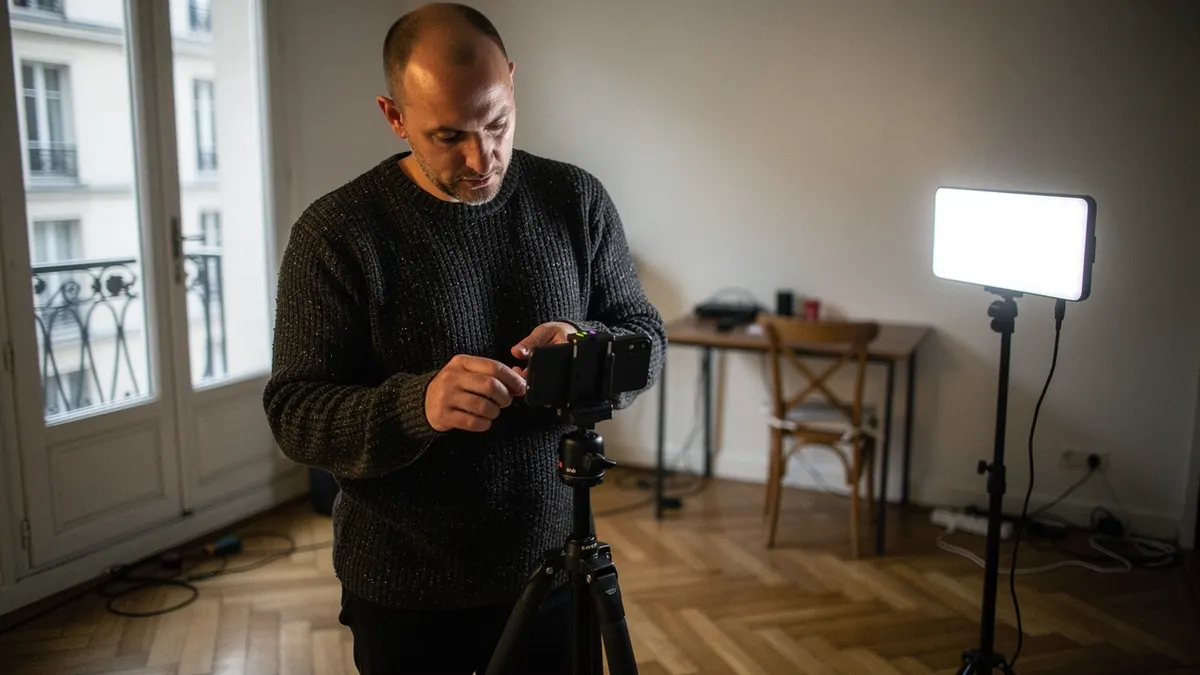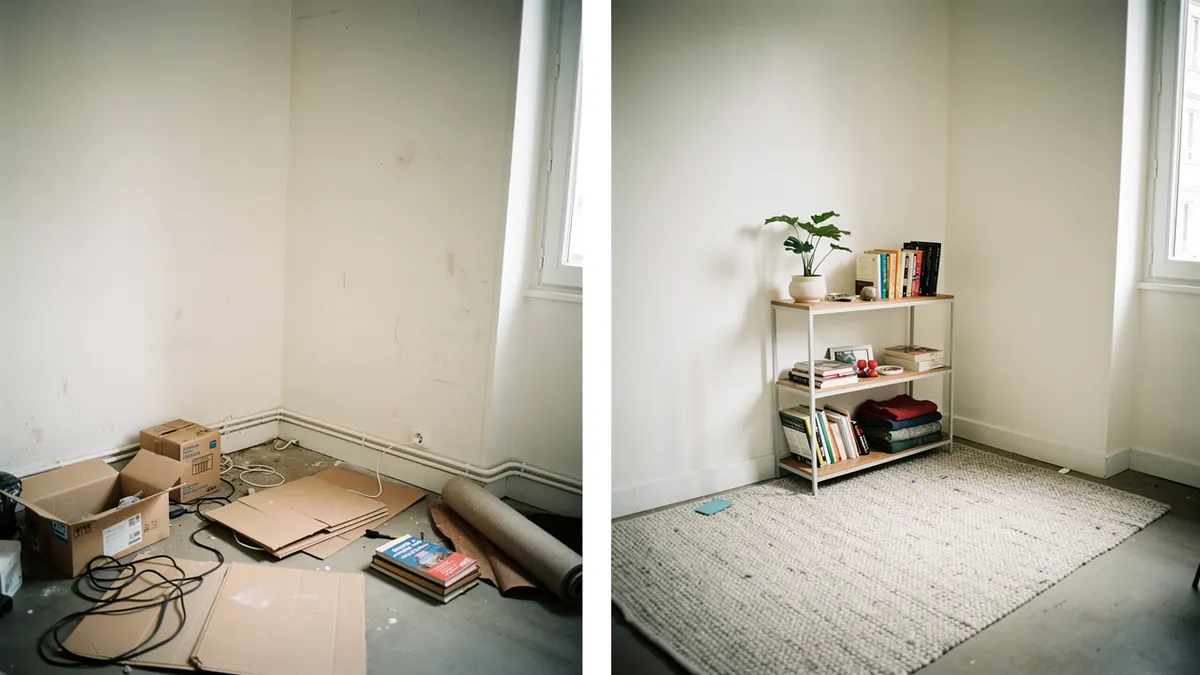
Before and after, the reality of small French flats, and how to brief creators whose home looks like your customers'.
What older housing forces you to show
Five realities the audience recognises immediately.
Walls that are not straight, which decides whether an installation is feasible.
High skirting boards, which stop furniture sitting flush against the wall.
Old, uneven floors, on which furniture does not stand level.
Old-style windows, which complicate any bracket or rail.
And the frequent ban on drilling in rented homes, a constraint deciding a large share of purchases.
One briefing consequence: explicitly ask for those obstacles to be shown rather than avoided. That is the content missing across the whole category.
Assembly is a moment of truth
Four shots worth every argument.
Opening the box, with what is actually supplied.
Counting the parts and the screws.
The real assembly time, said honestly and verifiable in the image.
And the difficult moment, the one where you have to start again, which reassures more than a flawless assembly.
One note: the assembly video is the most watched content in this category and the most rarely commissioned, because it does not flatter the product. Yet it sells better than the staging.
What French light changes
Four constraints specific to the climate and the buildings.
The light is short in winter, which reduces the shooting slots to a few hours.
It is often grey, therefore flat, which makes colours hard to reproduce faithfully.
Rooms often face one side only, which creates strong contrast between the window and the back of the room.
And textile colours look different by season, which has to be stated.
One honest practice: filming the product at two times of day, and saying so. A colour shown in two different lights avoids half the returns for a colour that does not match.
The calendar
Four strong periods.
January, the moment for tidying and rearranging.
Spring, the season of works and the big clear-out.
The September return, a period of moving and settling in.
And November, when buying shifts towards gifts.
Who to film
Three profiles that work.
The person living in housing comparable to the target audience's, a criterion more important than style.
The tenant, whose constraints are the most widely shared and the least covered.
And the person who has had the product for six months, the only one able to show wear and upkeep.
What decides the purchase of a home object
| The buyer's question | The shot that answers it |
|---|---|
| How big is it really | The object next to a hand or a chair |
| What is the material | A close-up with a finger rubbing it |
| How does it live in a room | A wide shot of the whole room |
What gives away a sloppy edit
Light that shifts between two shots of the same object. Filming the whole series at the same time of day settles it before the edit.
What is verified before naming a material
A wood species, an origin, a treatment or a standard. Each mention is read on the product sheet and confirmed with the brand, never estimated by eye.
What does not work
Four frequent mistakes.
The too-perfect interior, which resembles no real home.
The systematic wide shot, dealt with above.
Colours retouched at the edit, which produce returns.
And the total absence of dimensions, when that is the first information sought.
One last marker: in this category the video that sells is not the one making people dream of another flat, it is the one proving the object fits in the one they already have.
Sources
- Urssaf, official auto-entrepreneur portal
- Service Public, how to become a micro-entrepreneur
- Service Public, crossing the micro-entrepreneur turnover thresholds
Checked on 4 September 2026. Thresholds and rates change: where this guide and the official source disagree, the official source is right.