A media kit is not a presentation: it is a decision document. Here it reads like a quote, and that is exactly what is expected of it.
Start with the name of the document
That is the most neglected detail, and it decides its survival.
A file called "media kit" gets lost in a downloads folder. A file carrying your name, your speciality and the year is found again six months later, at the moment a need appears.
Apply the same rule to the link: it must stay valid, and open without asking for a login.
The order in which you are read
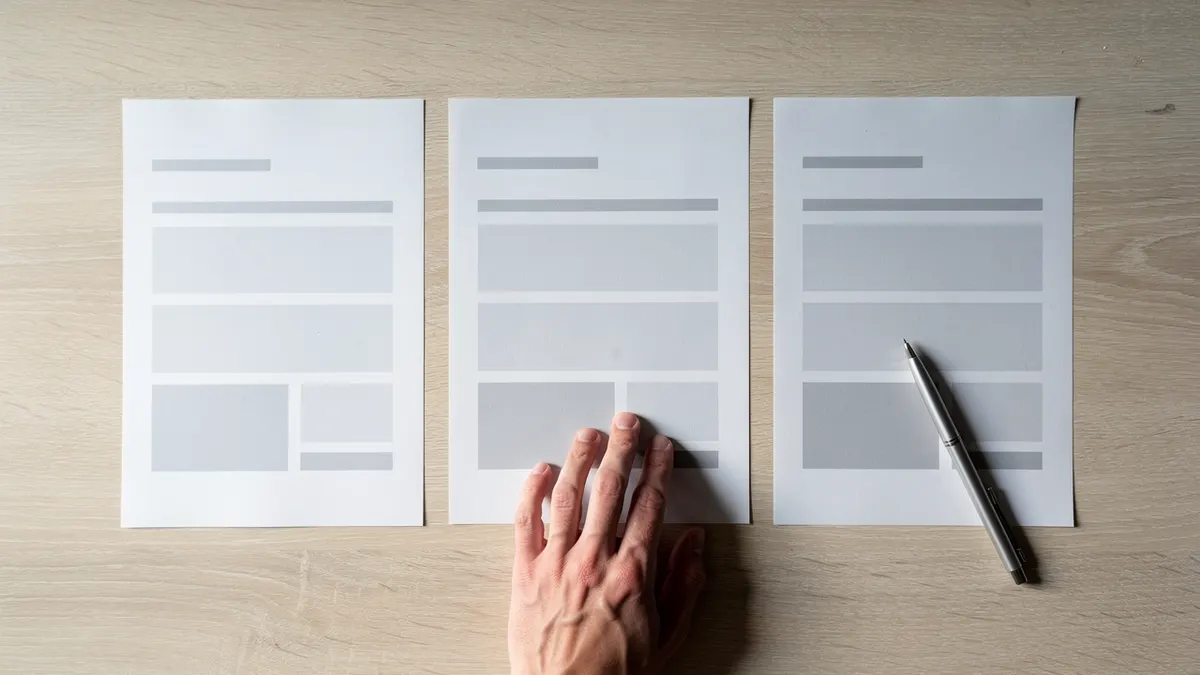
Five blocks, in that precise order, on a single page.
What you do, in one sentence: categories filmed, formats delivered, languages.
Two examples, not twelve, chosen in the recipient's category.
The services and the prices, with what is included and what is not.
The rights: duration, media, territory, and the price of an extension.
And the practicalities: standard lead time, rush lead time, how to reach you.
A hurried reader reads the first three blocks. An interested reader reads all five.
What to remove
Four elements present in almost every media kit and useless here.
The personal biography, unless it explains a shooting skill.
The audience figures, which do not interest a content buyer: they are buying files, not reach.
The logos of brands you have worked with, if you do not have permission to display them.
And the adjectives. A media kit reads like a technical sheet, not like a cover letter.
The format
A one-page document, readable on a phone, sent as an attachment and as a link.
The attachment serves when the person reads offline or forwards it to a colleague. The link serves when they want the up-to-date version.
Two technical rules. The file must stay light, because a corporate inbox rejects heavy attachments. And it must open with no account, no password and no particular application.
What agencies check before replying
Three points, in that order.
The consistency between what you state and what your examples show.
The clarity of the rights, because that is the line causing trouble later.
And the ability to invoice properly, described above.
An agency finding those three answers in the document replies. An agency that has to ask three questions often prefers to contact somebody else.
Maintenance
A media kit is updated twice a year, not after every job.
Three things change: the examples, which must stay recent; the prices, revised on a fixed date; and the list of categories, which narrows as you specialise.
Note the update date at the bottom of the page. A document dated two years ago gives the impression of a stopped business, even when it is running very well.
What a kit that gets a reply contains
| Page | Content | What the brand looks for |
|---|---|---|
| 1 | Three samples, the city, the languages | The quality |
| 2 | Formats, lead times, possible cadence | The feasibility |
| 3 | A firm price and terms | The decision |
What reassures particularly here
A price itemised line by line, a contract template attached and a clear sentence on data handling. Those three shorten the decision.
What has no place in it
A moodboard, a wall of logos with no campaign behind them, unreadable statistics screenshots, and any promise of results.
The two-language version
It doubles the prospecting surface, and it costs an hour.
Many companies here work with international teams, and a document available in both languages circulates more easily internally.
Make it one single file, with the two versions one under the other, rather than two separate documents to maintain in parallel.