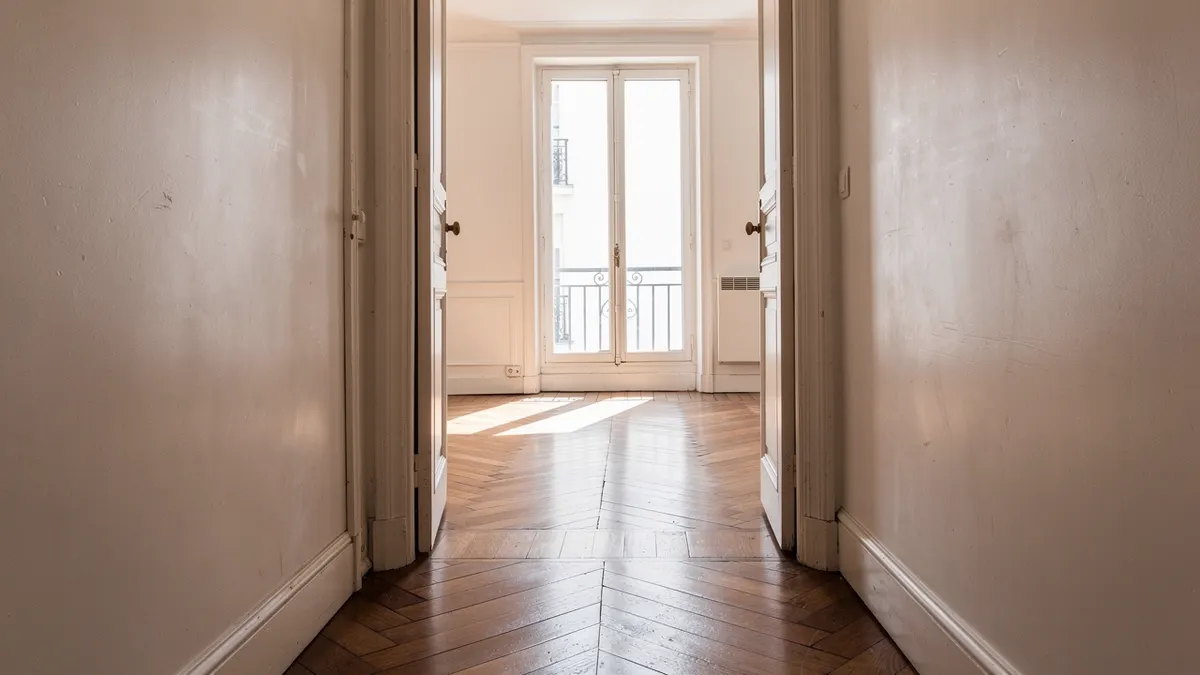
A filmed viewing saves time on both sides. It is also an advertisement, which imposes rules that photographs do not.
What a photograph cannot give
Three pieces of information, and they are the deciding ones.
The sequence of rooms: a filmed viewing shows what no floor plan conveys, namely the distance between the kitchen and the living room, the width of a corridor, the number of steps.
The real light, at a given hour, with no wide angle doubling the floor area.
And the noise: the street, the neighbours, the traffic, the train. It is the most sought-after and least supplied piece of information.
A viewing that is honest on those three points brings fewer visitors and more decided ones, which is exactly the aim.
The buyer checks five things
They can be filmed in a single take.
The real condition of floors, walls and joinery, filmed close up.
The brightness according to orientation, with the hour stated on screen.
The outside and the parking, including the real distance between the space and the door.
The communal areas, often absent from listings and often decisive.
And the immediate surroundings: shops, school, bus stop, showing the walk rather than a map.
What not to do
Four practices that backfire on the seller.
The systematic wide angle, which creates disappointment at the viewing and wastes everybody's time.
The fast edit over music, which prevents any understanding of the flow between rooms.
Hiding a visible defect: a crack, damp, a view onto a wall. It will be seen at the viewing, and trust disappears.
And the presence of people or unauthorised personal objects in the frame. The occupants' authorisations, and the handling of identifying elements, are settled before the shoot.
Which creators to hire
The useful profile is not the one people imagine.
You need somebody able to walk while filming without jolts, to handle a violent contrast between the interior and a window, and to record clean sound in an empty room that echoes.
Ease in front of the camera matters less than steadiness of movement. A filmed viewing is a long take, not a series of hooks.
Add knowledge of the neighbourhood, which allows them to say what a shot does not show: the Saturday market, the bus line, parking in the evening.
What a filmed viewing must respect
| Point | What is needed | Otherwise |
|---|---|---|
| Mandate | The owner's written agreement | No release at all |
| Occupants | The consent of anyone present | Mandatory blurring |
| Private items | Photos, mail, screens out of frame | Personal data published |
What is filmed in the order of a real viewing
The entrance, the living room, the kitchen, the bedrooms, the outside. A continuous route is understood, an edit jumping between rooms disorients.
What is never said on camera
A yield, an expected capital gain, an unverified charge amount or a summarised survey. Those points are referred to the official file, to be confirmed with a professional.
The French calendar
It is more marked than in other categories.
The market wakes up in spring, slows in high summer, has a second wave at the start of the school year, then stops at the end of the year.
The consequence for content: viewings are filmed before the peaks, when the light is good and the properties still available. A property filmed in December at three in the afternoon looks dark, even when it is not.
Two useful habits. Film every property as soon as it goes on the market, without waiting. And keep the neighbourhood, building and communal-area sequences: they will serve again for every property in the same place, which makes the production profitable over time.
Sources
- Urssaf, official auto-entrepreneur portal
- Service Public, how to become a micro-entrepreneur
- Service Public, crossing the micro-entrepreneur turnover thresholds
Checked on 4 September 2026. Thresholds and rates change: where this guide and the official source disagree, the official source is right.