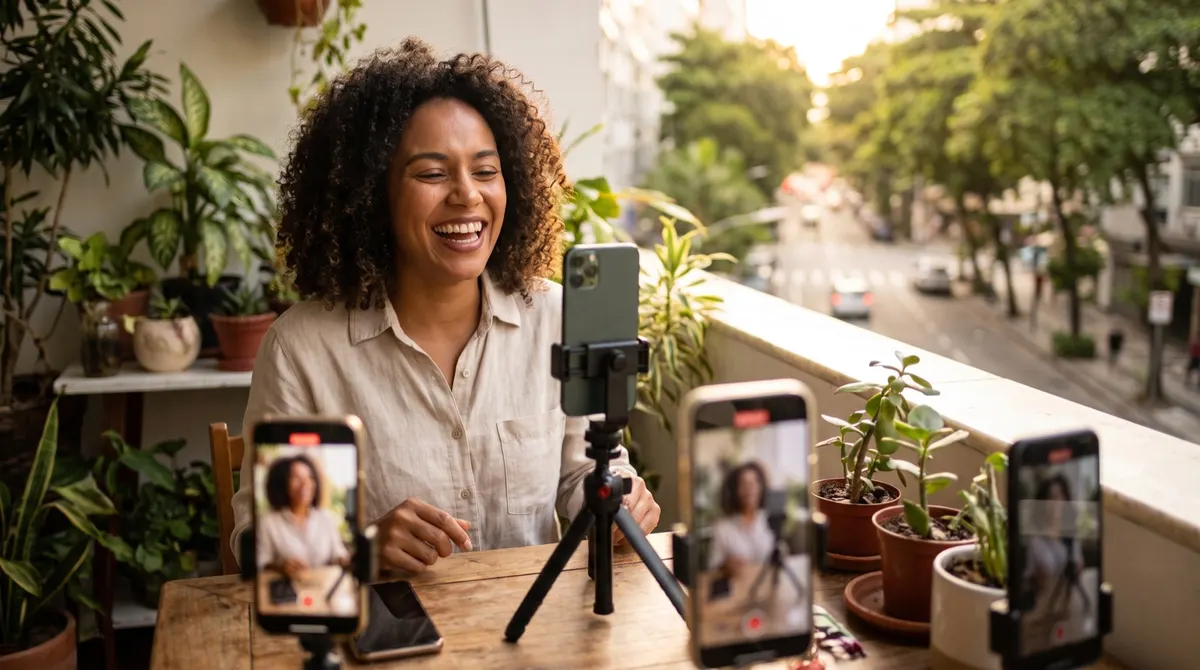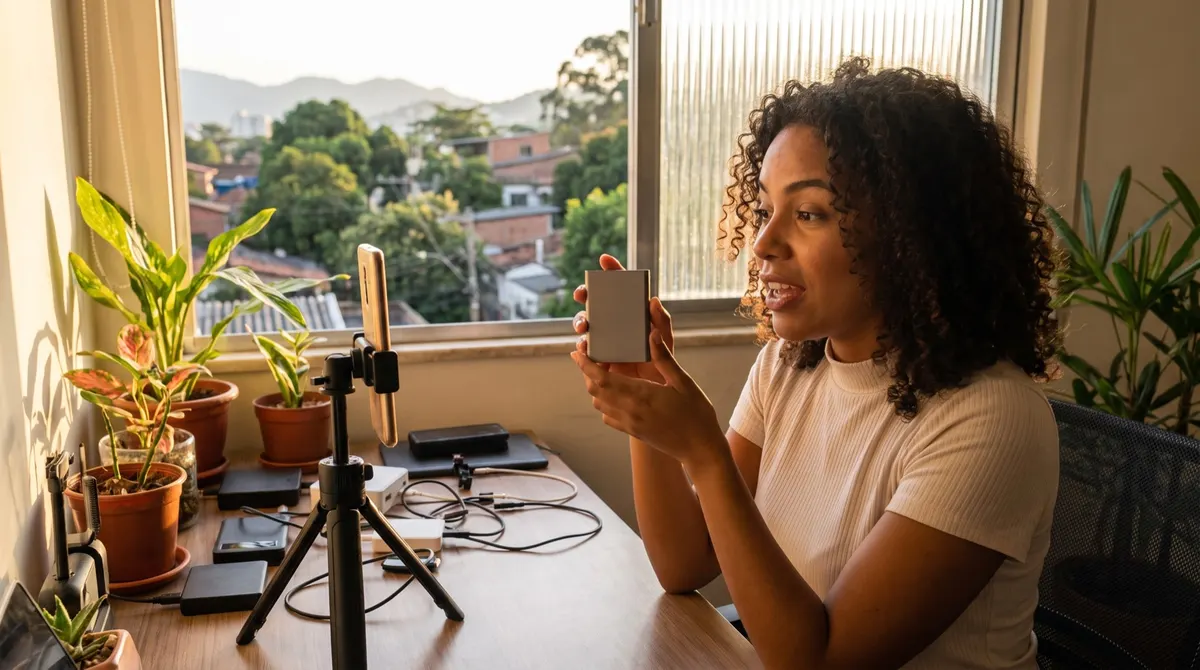
Tech and electronics as a UGC niche in Brazil, the formats that convert and how creators and brands collaborate.
Why tech products need UGC in Brazil
Six reasons specific to the market.
Prices are high relative to purchasing power, so the decision is long and the doubt strong.
Product pages are full of specifications nobody knows how to interpret.
Marketplaces mix items identical in appearance and very different in quality.
Returns are slow and costly, which pushes people to check before rather than send back after.
Compatibility is the first question, dealt with above.
And the installed base is old: many buyers use equipment several years old, which brand videos ignore.
What tech UGC covers
Six sub-categories, with what distinguishes them.
Phone accessories: the largest volume, the most impulsive purchase.
Audio: headphones and speakers, where sound demonstration is impossible and everything rests on use.
Small connected home devices, whose objection is installation.
Entry-level computing, where the question is lifespan.
Car accessories, an underestimated and much-requested category.
And creation equipment, camera, microphone, light, bought by people who know exactly what they are looking for.
The formats that convert for tech brands
Seven formats, ranked by effect on sales.
The compatibility test, dealt with above.
The complete installation in real time, with no cut, showing the real difficulty.
Scale and bulk: the product in the hand, in the bag, in the car.
The feedback after a month, which handles durability, the category's main worry.
The comparison with the previous device, when the person has owned both.
The contents of the box: what is supplied and what has to be bought in addition, information systematically absent.
And the answer to technical questions asked in comments, the most useful and least produced format.
How tech brands and creators work together
Six points to frame before production.
The list of configurations to show, decided in advance and not improvised.
The specifications the creator may state, and those belonging to a test they have not run.
The ban on comparing directly with a named competitor.
The length of the equipment loan, and what becomes of the product after the shoot.
The mandatory mentions tied to warranty, electrical safety and certification, whose arrangements are checked with the competent authorities.
And the duration of rights, often long in this category because the product stays in the catalogue.
Advice for creators entering the niche
Seven decisions to take before the first order.
Choose a sub-category and stick to it: audio, accessories or car, never all three.
Show your own equipment, including old items, because that is what the public owns.
Never state a performance you have not measured yourself.
Film the installation in one take, the proof hardest to contest.
Prepare a list of recurring technical questions in your sub-category, and answer them in every video.
Buy the common cables and adapters: they serve in almost every compatibility test.
And invoice the preparation time, longer here than elsewhere, because a test is prepared before it is filmed.
What is filmed on a technical object
| Shot | What it settles | What to avoid |
|---|---|---|
| The object in hand | Real size and weight | A white-background catalogue shot |
| Starting it up | The real setup time | A cut hiding a difficulty |
| A daily use | What it actually changes | A read-out list of specs |
What is missing from nearly every video in this sector
The flaw. A perfect object does not exist, and pointing out what bothers you makes the rest of the demonstration credible.
What is verified before stating a specification
A battery life, a compatibility, a standard or a throughput. Each is read on the datasheet and confirmed with the manufacturer, because a wrong figure then circulates in every reuse of the video.
What gets a delivery refused
Five frequent mistakes in this niche.
Reciting the product page's specifications, immediately recognisable.
Filming a connection off screen, which cancels the proof.
Showing a use that supposes equipment the public does not have.
Stating a compatibility without having tested it, which produces returns and negative comments.
And forgetting to say the model and year of your own device, information that gives the test all its value.
One last marker: in tech, the most profitable video is not the one showing the product at its best, it is the one showing that it works with an ordinary, slightly old device, in a real home. That is exactly what the brand cannot film itself.
Sources
Checked on 27 August 2026. Thresholds and rates change: where this guide and the official source disagree, the official source is right.