The comparison is nearly always framed in terms of budget. That is the wrong axis, because the two options do not make the same thing and do not live at the same pace.
In Argentina it is the pace that decides.
A video can become untrue before it is even published
An offer changes, an item goes out of stock, a promotion ends, a payment condition shifts. The video that announced last week's state of affairs no longer tells the truth.
A production run by an agency is designed in long cycles: brief, approval, shoot, edit, feedback. By the time the piece comes out, the situation it describes may have moved, and it can no longer be reworked without restarting the whole cycle.
A creator redoes a piece in two days, with the same product and a different script. That capacity for correction is often worth more than the finish.
What a production does better, and should not be taken from it
Brand image. The film presenting the company, the piece meant to last, the one shown to a distributor or a partner.
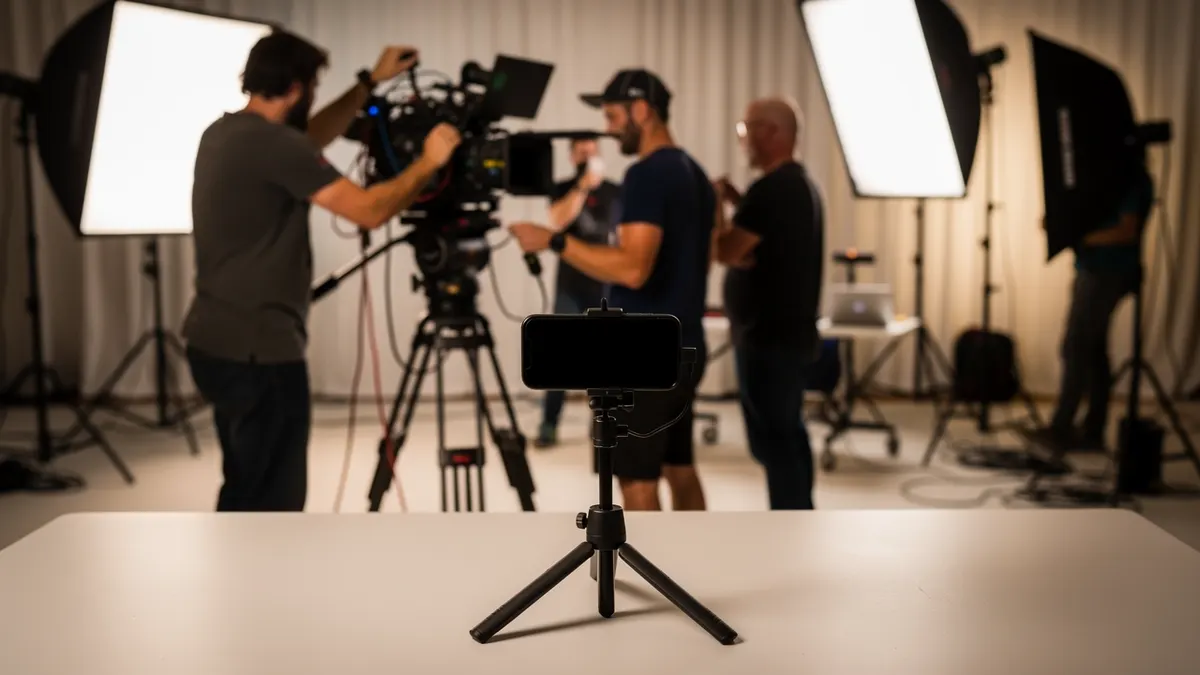
The technique impossible elsewhere: a product filmed in extreme close-up, a machine running, a scene requiring light and time.
And consistency: when several markets must receive exactly the same thing, production guarantees a uniformity ten creators will never provide.
What the creator does better
Volume and variation. Ten different hooks for the same product, tested and replaced, which is the only way to keep an ad working over time.
Closeness: an interior resembling the customer's, ordinary light, a voice that is not an actor's voice.
And answering the objection: someone saying what made them hesitate and then what decided them. An agency can write it, but it cannot embody it.
The honest calculation
Comparing the price of an agency video with a creator video makes no sense: you are not comparing the same lifespan.
The right unit is cost per usable variant. A magnificent production yielding a single piece costs a lot per variant; a set of decent pieces yielding fifteen costs little, and that is what a paid campaign needs.
Add what nobody counts: internal time. A production requires approvals, meetings, back and forth. That time is real, it is simply invisible on the invoice.
What the brands that manage well do
They keep one production a year for what has to last, and buy creator content continuously for everything that has to move.
They then use the pieces that worked as a brief: instead of imagining a next campaign, they have what already delivered results remade, with another face and another setting.
What each route gives
| Need | Creator | Production company |
|---|---|---|
| Three formats in five days | Yes | Rarely |
| Several people on camera | Difficult | Yes |
| Cost per variant | Low | High |
What tips it toward a creator
A monthly need, a product that films at home, a budget per piece rather than per campaign.
What tips it toward a production
A multi-camera shoot, a location to close off, a release on television or in cinemas.
The most frequent mistake
Asking a creator for a production aesthetic. You then pay the price of a light shoot to obtain a poor imitation of an advertising film, and you lose exactly what you came for: the impression that this is not an ad.
The reverse is true too: asking an agency to manufacture content that looks spontaneous gives a result the viewer spots, at full price.