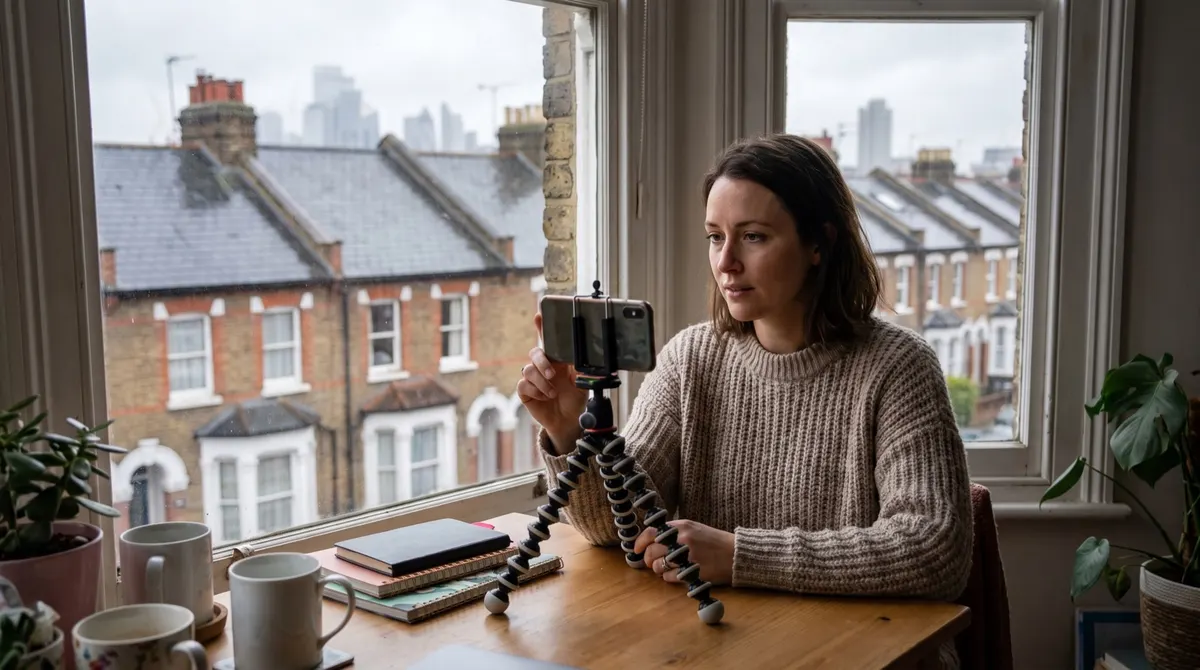
How to start with no audience: what you actually need, the first three videos, the portfolio, your first prices and your first brands.
What the job actually is
You film videos for a brand, which runs them itself on its accounts or in advertising. You are not selling an audience, you are selling production: a delivered file, with a usage right. That is why an account with two hundred followers can charge as much as one with a hundred thousand.
What you need to start
Seven things, not one more.
A recent phone, even two years old.
A window.
A simple lavalier microphone.
A tripod.
Two tidy square metres of space.
Free editing software.
And three products you already use.
What you do not need
Six purchases to postpone.
A camera.
A studio.
A ring light.
A green screen.
Paid software.
And an audience.
The skills that make the difference
Seven abilities, by order of impact.
Writing a hook that fits in one sentence.
Speaking to camera without reciting.
Showing a gesture rather than describing it.
Holding a stable frame.
Getting clean sound on the first take.
Following a brief to the letter.
And delivering on the announced date.
The first three videos to shoot
A demonstration, a nuanced verdict, an answer to an objection. Three formats, three different products, filmed in the same week. That trio covers most of what a brand tries to verify before ordering.
What each video must prove
Six expected proofs.
That you can frame a shot.
That your sound is audible.
That you speak naturally.
That you can show a product.
That you can hold a short length.
And that you know how to close.
How to build a portfolio that converts
Seven rules.
Six videos maximum.
The best one first.
One dominant category.
Sound on for every example.
A clearly stated language.
An announced delivery time.
And no video older than a year at the top.
How to introduce yourself in one sentence
Six elements to hold together.
Your main category.
Your language.
Your country.
The kinds of format you deliver.
Your usual turnaround.
And what you do not do.
How to find your first brands
Seven channels, from the fastest to the slowest.
Signing up on a marketplace.
Answering published listings.
Writing to brands you are a customer of.
Spotting brands already running ads.
Looking at who orders in your category.
Joining specialised communities.
And answering any brand that contacts you, even a small one.
The pitch message that gets a reply
Seven elements, in six lines.
Naming the specific product.
Saying what you noticed.
Offering a concrete angle.
Attaching an example from the same category.
Giving a starting price.
Announcing a turnaround.
And asking one single question at the end.
How to set your first prices
Six markers.
Count the real time, filming and editing.
Add the exchange time.
Look at the prices shown in your category.
Invoice rights separately.
Do not go below your break-even point.
And raise them after five delivered orders.
What to send with the delivery
Six elements, in the same message.
The link to the files, with no short expiry.
The list of formats delivered.
The length of each video.
A reminder of the rights granted.
The deadline for asking for a revision.
And one sentence on what you suggest next.
What is billed on top
Six services.
Advertising rights.
A longer licence duration.
An extra format.
Subtitles in another language.
An expedited delivery.
And running from your own account.
How to get paid without risk
Six simple rules.
Never film without a written order.
Ask a new client for a deposit.
Write down the payment date.
Deliver in a private space, not by public messaging.
Go through a platform that frames the order.
And refuse payment conditioned on the video running.
The mistakes that cost jobs
Seven frequent errors.
Waiting for gear before starting.
Showing fifteen videos instead of six.
Answering three days after a message.
Accepting a vague brief.
Cutting your price at the first refusal.
Delivering without respecting the requested format.
And disappearing after delivery.
The rhythm of the first three months
Seven steps, week by week.
Week one, film three videos.
Week two, create the profile and the packages.
Week three, send thirty messages.
Week four, deliver the first order.
Month two, add two videos to the portfolio.
Month two, ask for a first review.
And month three, raise the starting rate.
What to refuse at the start
Seven requests to rule out, even as a beginner.
A free video in exchange for exposure.
Advertising rights not invoiced.
A brief given only over the phone.
Payment promised after the video runs.
Unlimited revisions.
Buying the product yourself with no compensation.
And an unpriced exclusivity.
How to know it is working
Six measurable signals.
One reply per five messages sent.
An order within the first six weeks.
A second message from a brand already served.
A review quoting a deadline or a result.
A production time that keeps falling.
And an unprompted request.
The four steps of starting up
| Step | What you produce | The time |
|---|---|---|
| The set and the sound | A ready shooting corner | Half a day |
| The first three videos | A minimum portfolio | Two days |
| The profile | City, languages, rate, lead time | One hour |
| The first applications | Five replies to listings | One hour |
What decides the first order
The sample closest to the requested product. A varied portfolio impresses less than a single video resembling exactly what the brand wants to sell.
What is put in order from the first income
The filing framework and the invoicing. The applicable status, the thresholds and the invoice format are confirmed with an accountant; they vary by country of establishment.
What the platform brings
On UGC MATCH, joining is free and there is no subscription: you create your own packages, you are visible by category and by language, and the order frames the brief and the delivery. The brand pays at ordering, the funds are not released straight away, and payment goes out on approval. The platform retains 10% of the price on the creator side, who therefore keeps 90%, and charges the brand a 6% service fee, with a minimum of 1.50 EUR.
One last marker: this work does not reward the person with the best gear, it rewards the person who has delivered three times running on the announced date.
Getting paid safely (the thing that changes everything)
Every beginner creator's nightmare: delivering a video and never getting paid. That's exactly what a secure payment protection system solves.
On a platform held by Stripe, when a brand orders, their payment is locked in from the start. You deliver the video knowing the money is already secured. Once the brand is satisfied, the funds are released to you. No more "I'll pay you later," no more unpaid invoices. This is the standard you should demand.
Five habits that cost you a client
- Selling yourself short from day one and never daring to raise your rates.
- Neglecting the hook: a great video with a weak opening won't get watched.
- Delivering off-brief: reread the instructions, respect the requested angle.
- Working without a payment framework: always require secure payment protection.
- A catch-all portfolio: 4 excellent videos beat 15 mediocre ones.
Your action plan
- Shoot 3 practice videos using products you have at home.
- Edit them cleanly (hook + captions).
- Create your free creator profile and publish your packages.
- Get your first orders, deliver, and get paid safely.
- Collect reviews, raise your rates, and turn brands into repeat clients.
The craft is learned by doing. The best day to shoot your first video is today.