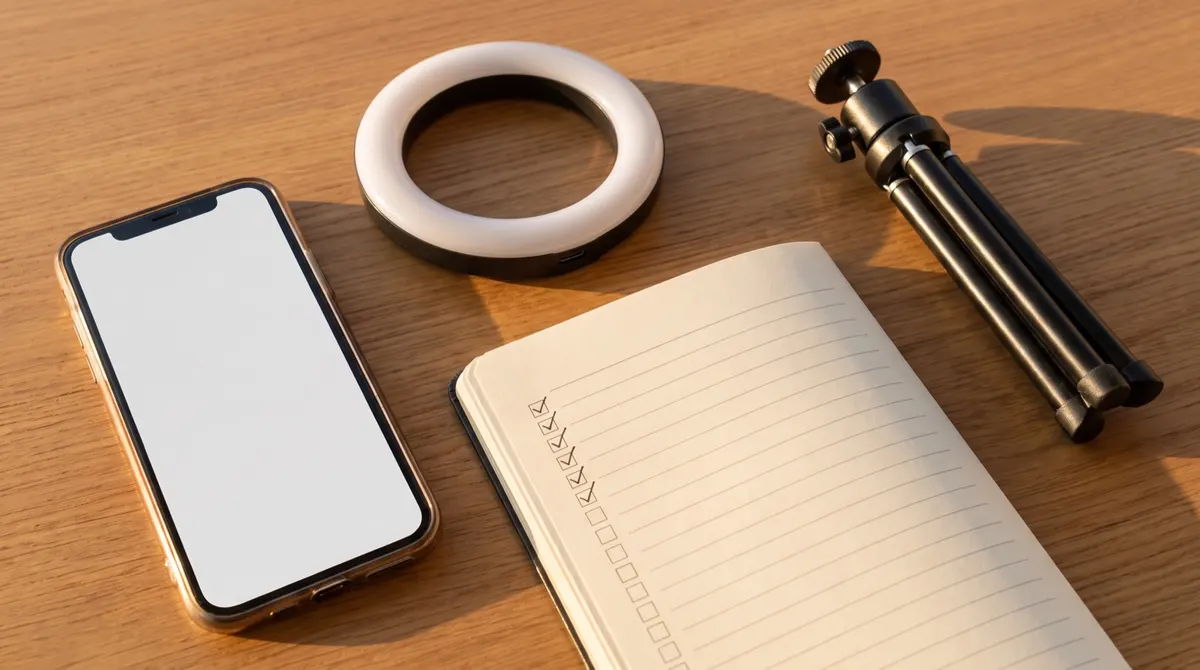
From the first orders to an established activity: sharpening the craft, raising rates, winning repeat work and building a niche.
Where you are on the curve
Three stages almost always follow each other: the first orders, where you accept everything; stabilisation, where you choose; and establishment, where you refuse. Progress is not measured in videos delivered, it is measured by what you can refuse without fear.
What improves first
Six skills, in the usual order.
The sound, fixed after the first remark.
The framing, steadied after five shoots.
The hook, sharpened after twenty videos.
The editing rhythm, once the rest is in place.
The script direction, later.
And the ability to refuse a badly framed brief, last.
How to improve the hook, the edit and the sound
Seven concrete exercises.
Rewrite the hook of your last three videos.
Test two versions on the same video.
Delete the first sentence and see if it holds.
Start on a gesture rather than a word.
Ask the buyer's question, as it is.
Watch your videos with the sound off.
And note the hook that worked best.
How to improve your editing
Six reflexes.
Cut before the gesture is finished.
Remove the useless pauses.
Keep the product's real sound.
Avoid decorative transitions.
Cut the total length by a quarter.
And watch the video on a phone before delivering.
How to improve your sound
Six corrections that show immediately.
Bring the microphone closer to the source.
Turn off any ventilation.
Avoid empty rooms.
Check the level on headphones before the take.
Redo a take rather than fix it in the edit.
And record one second of silence before speaking.
When to raise your rates
Six legitimate moments.
After five delivered orders.
After a review that quotes a result.
When you are turning orders down.
When your turnaround is lengthening.
When you add a format to the package.
And once a year, on principle.
How to announce an increase
Six rules.
Give a month's notice.
Announce, do not negotiate.
Add something to the package at the same time.
Apply it to new orders only.
Do not justify yourself beyond two sentences.
And accept losing the least profitable client.
How to win repeat orders
Seven moves after every delivery.
Write eight days later.
Ask what worked.
Offer two ideas for the next step.
Include an extra format on the next order.
Note the date of the next launch.
Offer a batch rather than a single video.
And come back before the brand looks elsewhere.
What turns an order into a monthly retainer
Six conditions.
Three orders already delivered.
A regular need, not a seasonal one.
A capped number of videos.
A written feedback turnaround.
Notice on both sides.
And a price reviewed every six months.
How to build a niche
Six steps.
Look at your last six videos.
Spot the category that keeps coming back.
Keep only those examples at the top of your profile.
Write the category as the first word.
Turn down two off-niche orders.
And publish a result from that category.
What a portfolio must prove
Six proofs.
That you can frame a shot.
That your sound is clean.
That you hold a short length.
That you follow a brief.
That you deliver several formats.
And that you work in one precise category.
How to collect reviews without thinking about it
Six automatic habits.
Ask on the day of approval.
Ask one precise question.
Give the direct link.
Offer two possible phrasings.
Follow up only once.
And thank them a second time later.
How to become easier to find
Six profile settings.
A clearly announced category.
A stated language and country.
Three priced packages.
A displayed turnaround.
Recent examples at the top.
And one line on what you do not do.
When to add a language or a market
Six signals.
You receive requests in that language.
Your category is in demand in that country.
You can deliver clean subtitles.
You know the local habits.
Your setting stays believable.
And you can reply in that language.
How to prepare for the busy season
Six preparations, a month ahead.
Tell regular clients about your availability.
Block filming slots in advance.
Build a stock of backgrounds and props.
Prepare two quote templates.
Reduce the number of categories accepted.
And turn down new off-niche clients.
The habits that compound
Seven simple routines.
Review three deliveries every month.
Note one correction per order.
Back up the raw footage in the same place.
Keep a table of clients and dates.
Follow up with clients at two months.
Block one day with no shoot.
And raise one price once a year.
How to analyse a video that worked
Seven questions to ask.
What exactly was the hook.
How long before the first gesture.
Which shot opened the video.
Which objection was handled.
What was the total length.
What was the setting.
And what could be repeated elsewhere.
What to stop after ten orders
Seven beginner habits.
Accepting a verbal brief.
Delivering with no accompanying note.
Folding the rights into the price with no separate line.
Accepting unlimited revisions.
Answering at any hour.
Rebuilding the setting for every shoot.
And underestimating the editing time.
How to handle several orders in parallel
Six organising rules.
Group the week's shoots.
Edit the whole batch on the same day.
Name the files at export.
Keep a list of expected deliveries.
Never promise two deliveries on the same day.
And keep a day of margin per order.
What to measure every month
Six figures, noted in the same place.
The number of orders delivered.
The net income received.
The real time spent per video.
The average number of round trips.
The number of new clients.
And the number of returning clients.
How to learn without buying a course
Six free and effective sources.
Watch the ads in your category.
Analyse three videos that made you buy.
Remake an existing video your own way.
Ask a client for precise feedback.
Compare your last two deliveries.
And read the briefs you receive, carefully.
The signs you are stalling
Six signals not to ignore.
The same rate for a year.
The same clients, with no new ones.
The same format on every order.
No recent review.
A production time that stops falling.
And no refusal in six months.
What you work on, in order of impact
| What you improve | The effect | The delay |
|---|---|---|
| The sound | The strongest | Immediate, with a mic |
| Light consistency | Strong | A week of habit |
| The edit's pace | Moderate | A month of practice |
| The hook's quality | Strong | The time to test five versions |
What you measure to know whether you are improving
The number of takes needed to get the right one. When it drops from five to two, the progress is real, whereas perceived quality is hard to judge on your own.
What lifts income, not just the video
Selling more than shooting: the edit, the variants, the languages and the rights. Same working day, invoiced two to three times better, with no gear purchase.
What the platform brings
On UGC MATCH, joining is free and there is no subscription: you publish your own packages, you are visible by category, language and country, and reviews are tied to real orders. The brand pays at ordering, the funds are not released straight away, and payment goes out on approval. The platform retains 10% of the price on the creator side, who therefore keeps 90%, and charges the brand a 6% service fee, with a minimum of 1.50 EUR.
One last marker: progressing does not mean doing more, it means doing the same thing better, until it becomes fast.
Sources
- Portal do Empreendedor (MEI), Brazilian government
- Receita Federal, Brazilian tax authority
- Simples Nacional, official portal
Checked on 4 September 2026. Thresholds and rates change: where this guide and the official source disagree, the official source is right.