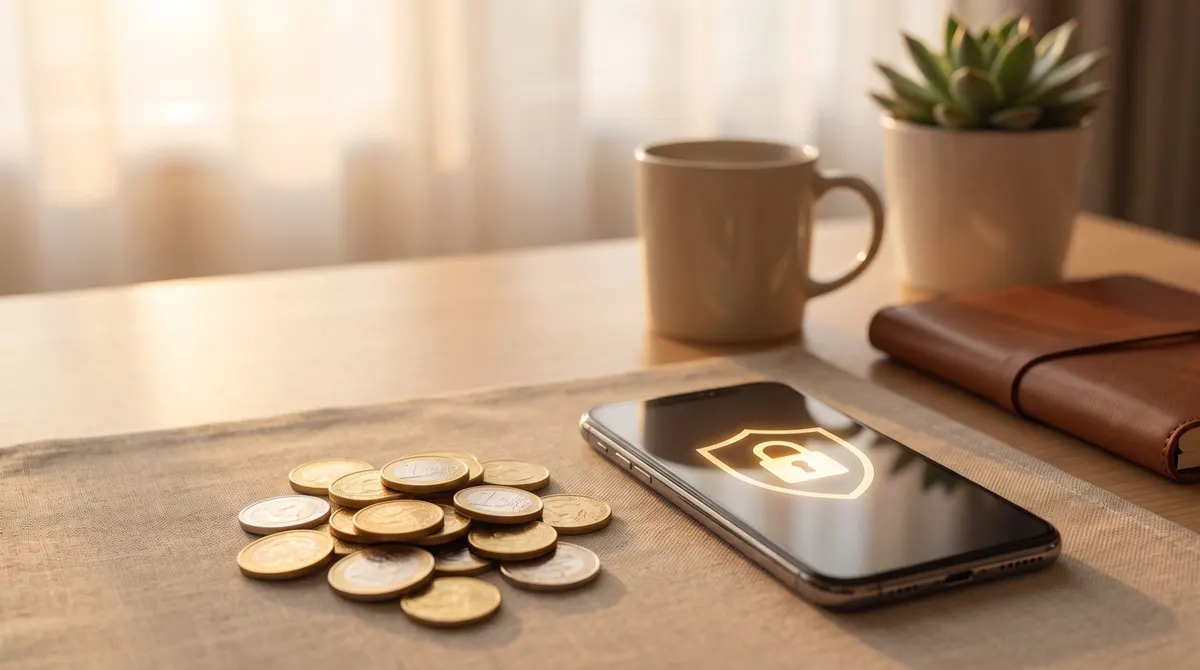
Secure payment is when the buyer's payment is held by a trusted third party and released to the seller only after approval, protecting both sides.
Secure payment in one minute
Seven points to understand the principle.
The buyer does not pay the seller directly, but commits the sum with a payment provider.
The seller sees that the order is funded, which allows them to start without risk.
The sum is only released after the delivery is approved.
Approval deadlines are stated in advance and known to both parties.
The mechanism protects against non-payment as much as against non-delivery.
It does not replace a contract, it guarantees its financial execution.
And it makes the relationship possible between two strangers, which is exactly the case in UGC.
How it works in a UGC order, step by step
Seven steps, in their real order.
The brand chooses a package and confirms its order.
The payment is authorised, dealt with above, and the order becomes visible to the creator.
The creator accepts, which starts the delivery period.
The product is sent if the assignment includes one.
The creator delivers the video in the order area.
The brand approves, or requests the planned round of corrections.
And approval triggers the capture and then the payout, according to the stated schedule.
The three moments, in practice
Six concrete consequences of that separation.
An order can be paid without the creator having been paid, which is normal.
An authorisation can expire if the order stays blocked too long.
A cancellation before capture produces no movement of money, only the release of the reservation.
The brand's bank statement sometimes shows a pending operation, which is not a debit.
The creator sees the status change before seeing the money, which is the expected behaviour.
And payout times depend on the payment provider, not on the brand's goodwill.
Why it protects creators
Seven concrete protections.
Work only starts once the order is funded.
Price and scope are set before the shoot, in the order.
The delivery date and the number of corrections are written down.
Payment no longer depends on the brand's cash flow.
Silence from the brand after delivery does not block settlement indefinitely, since a deadline is provided.
The order history serves as proof in case of disagreement.
And the creator does not have to chase a client to be paid, which is the first reason people leave this work.
Why it protects brands
You never pay for nothing
The money is only released after the video is received. If nothing is delivered, nothing is captured, and the reservation is released. That is the difference with a transfer made in good faith to an unknown supplier.
Built-in quality control
Approval is not a formality: it is the moment when the brand checks that the video matches the brief, in the requested format, with the planned round of corrections if necessary.
A dispute that can be handled cleanly
In case of disagreement, the discussion is about written, dated elements: the brief, the delivery, the corrections requested. That is what makes a dispute resolvable, whereas a verbal agreement almost never is.
What secure payment does not cover
Six limits to know.
It does not replace the usage licence, which remains a separate contractual point.
It does not judge artistic quality, only conformity with what was ordered.
It does not cover later uses of the video, which fall under the negotiated rights.
It does not remove anyone's tax obligations, which are checked with an accountant.
It does not protect against a badly written brief, the main real cause of disputes.
And it does not replace communication: most blockages come from an unanswered message, not from the payment.
What this mechanism changes for each side
| Stage | For the brand | For the creator |
|---|---|---|
| At ordering | The amount is committed | Work starts on a safe basis |
| During production | Nothing has left yet | The order is real, not hypothetical |
| At approval | The payment is released | The transfer follows |
What it does not replace
A precise quote. The mechanism secures the payment; it defines neither the deliverables, nor the rights, nor the deadlines. A vague agreement stays vague even when the money is protected.
How it works with us
Signing up and the profile are free, the brand pays at ordering, funds do not leave immediately, the transfer follows approval, and the platform keeps 10% on the creator side.
How UGC MATCH uses secure payment with Stripe
Six operating elements.
Payment is processed by Stripe, with an authorisation at the order.
Capture happens on approval of the delivery, following the mechanism described above.
The payout to the creator follows a separate payment rail, with its own reference.
The applicable fees are displayed before payment, on the brand side as on the creator side.
The order status permanently shows the current step.
And all exchanges stay attached to the order, which serves as a file in case of disagreement.
One last marker: secure payment does not make a collaboration good, it makes it possible. What decides the result remains the brief, the clarity of expectations and the speed of replies; the payment mechanism merely guarantees that delivered work will be paid and that money paid will correspond to delivered work.